Month: January 2015 (page 1 of 2)

Smith Frontman ChromaPop Review

So there I found myself standing in Solly’s Anglers Corner Pretoria in front of their sunglass display, with my mind pretty much made up even before I got there. I wanted a pair of Costa Del Mar 580G polarized sunglasses. After reading many reviews and after hearing only good things about Costas from friends who have used them over the years, I simply went to Solly’s to choose a style that suited my face.

A pair of Costa Zane sunglasses grabbed my attention and so took them from the display and I put them on my face. I walked out of the shop and had a look through them at the outside world. It was a typically sunny; Pretoria summer’s day and there was an array of objects and colours to look at through the green tinted, copper lenses. I was impressed with the build quality and the clarity was amazing.

I have been using a pair of Ray Ban polarized sunglasses for the last 2 years and there was a massive difference in clarity and contrast between the Ray Bans and the Costas. Younis came outside and gave me a pair of Smith Frontman sunglasses with brown polarized lenses to try on.

FNPPBRTT.jpg

These lenses had the new Smith ChromaPop technology that everyone was ranting and raving about. He told me that the Smiths are just as good as the Costas (if not better) and that a lot of professional fly fishing guides had recently switched over from Costas to the Smiths. I was sceptic, but to be fair I gave them a try and to my surprise they were absolutely brilliant. They were light and they fitted my melon snug and secure, plus they looked really great.

It was a tough choice between the two, but as the Smits looked a bit less fishing specific, I took the Smiths Frontman ChromaPops. The problem with the Costas (to me personally) was that they would look a bit peculiar for everyday use. The Frontman looks great everywhere; whether you are lying on the beach, fishing your favourite beat or going to town. They have a modern look about them but they don’t make you look like a yuppie, which is always a good thing.

But be warned, they don’t make you look like Brad Pitt either; unless off coarse if you look like Brad Pitt’s twin brother…

DSC_0020.jpg

I bought my Smiths a day before we went on holiday to the coast and they were great to drive with (1400km) in all light conditions, even in the mist and cloudy weather. One of the most impressive features for me about the ChromaPop lenses is when you look at bright colours such as green, orange and pink you will be amazed at how those colours come to life. Even dull colours and low light conditions become clear and crisp. It eliminates glare like no other pair of polarized sunglasses that I have ever fished with and they don’t fog up easily.
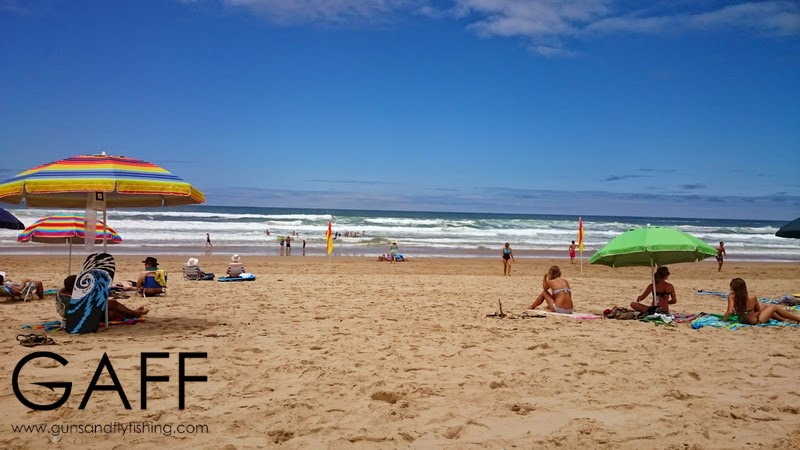
DSC_0099.jpg

One morning, just after arriving at an estuary to target some Garrick on fly, I noticed that there was something on both of my lenses. Initially I thought that it was sand or something, but I didn’t recall dropping them on the beach or anywhere else the previous day.
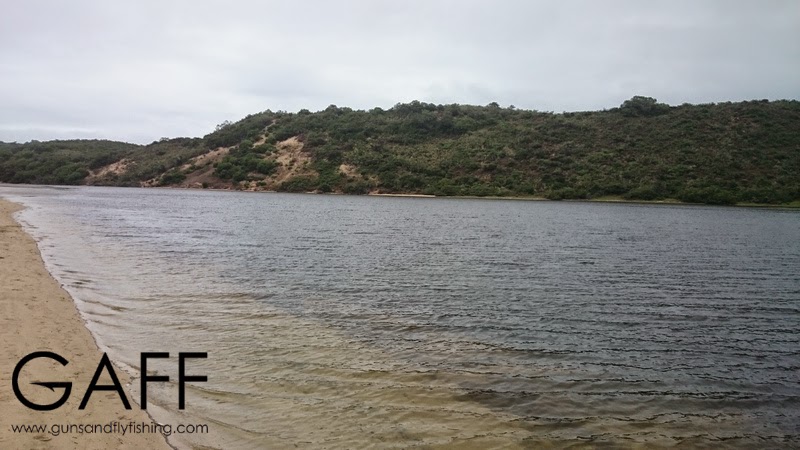
DSC_0116.jpg

After cleaning them with the orange pouch/cloth provided in the hard case (you get with every pair of Smith ChromaPops), I was shocked to find that the lens film was starting to flake off. I couldn’t believe that this happened after only two weeks of driving around, fly fishing in estuaries and lying on the beach.
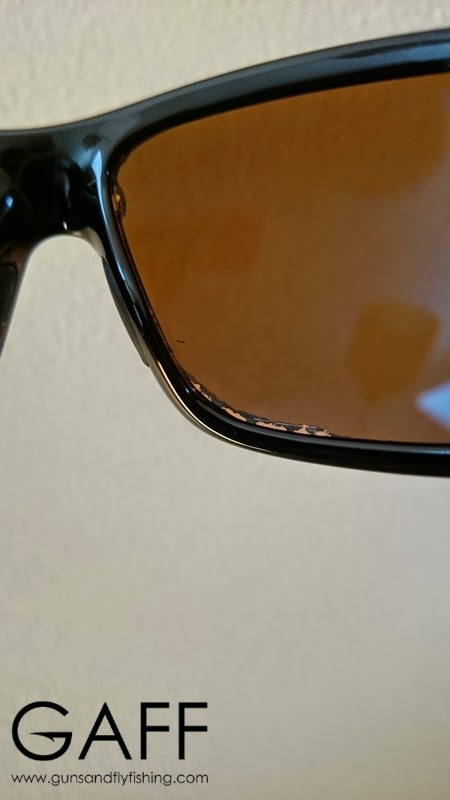
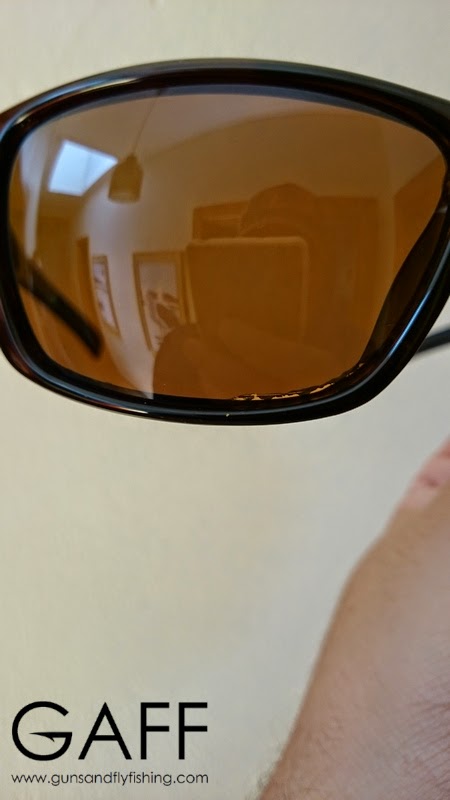
DSC_0094.jpg DSC_0095.jpg

As you could imagine, I then regretted buying the Smiths instead of the Costas and I was truly disgusted. I phoned Younis and told him about what happened; he then said that I could return them as soon as I was back in town. We spent another week on holiday at the coast and after arriving back home I took them in to Solly’s who then sent my Smiths back to the suppliers the following day. A week later I had a brand new pair of Smith Frontman sunglasses, at no extra charge. So rest assured, the after sales service is excellent.

I have worn them for about three weeks again, and they have not shown any signs of defect. I must be completely honest; I adore my Smiths, even if I had a little bad luck with my first pair. They retail somewhere in the region of R3000, depending on the style and lens. The ChromaPop lenses are really superb and I wouldn’t think twice about buying another pair. The only thing that I do not like about them is that the frame feels a bit plastic when compared to the Costas, but other than that I have no issues with the Smiths at all.

ChromaPop Lens Technology from smith optics on Vimeo.

Smith has been in the optic industry for a while now and the time and effort that they have put into the ChromaPop lens technology certainly shows. If you are looking for a new pair of polarized sunglasses that you can wear everywhere, then don’t hesitate; go and get yourself a pair of Smiths optics with ChromaPop lenses, you will be impressed.

© 2015 Guns and Fly Fishing. All Rights Reserved.
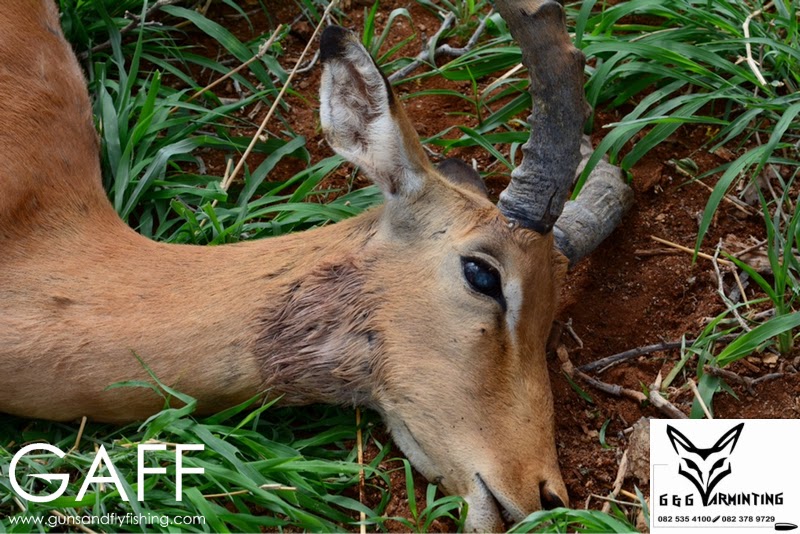
Hunting Jackal and Caracal

By Geno Van Niekerk

For the better part of 300 years livestock farmers (and more recently game farmers) in Southern Africa have been plagued by Black Backed Jackal (Canis mesomelas) and Caracal (Caracal caracal). It is estimated that Black Backed Jackal and Caracal kill approximately 5500 Lambs PER DAY in South Africa and Namibia. Those 5500 Lambs could have fed in the region of 165 000 people were they to reach a mature age.

Multiply that by 365 and you could have fed 60 225 00 (60 million odd) people over a year’s time with the livestock killed (approximately 2 007 500 sheep) by Black Backed Jackal and Caracal. Now in a country (and continent) where we have a high rate of poverty and where millions of people go to bed hungry each night, you can see why there is a need to control these animals that are killing the livestock.

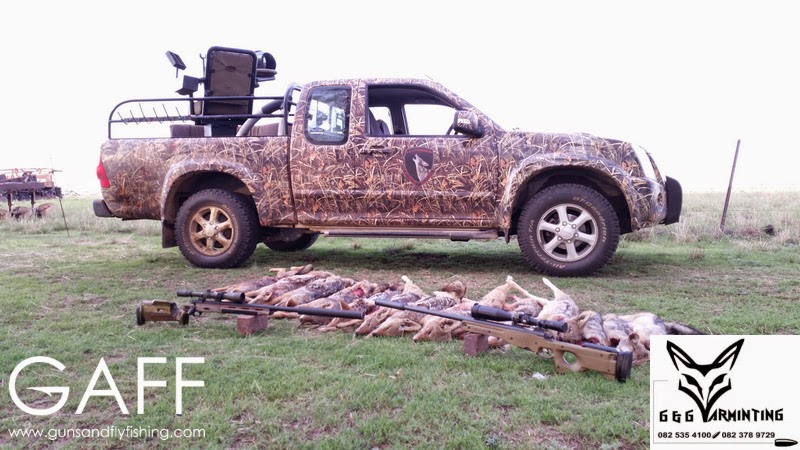
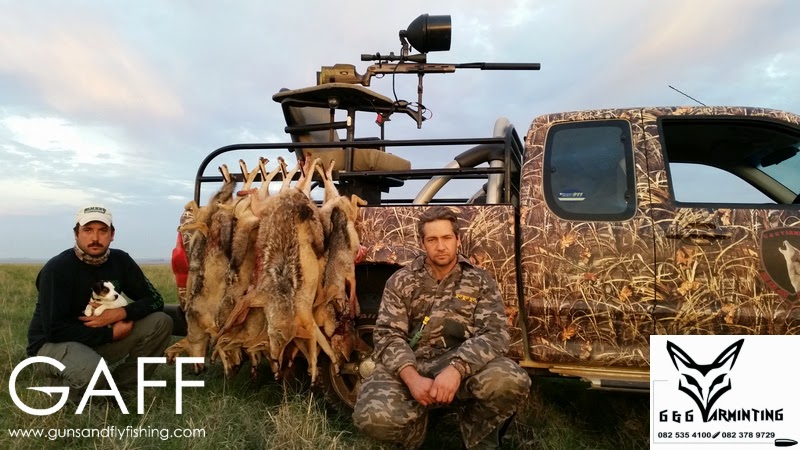
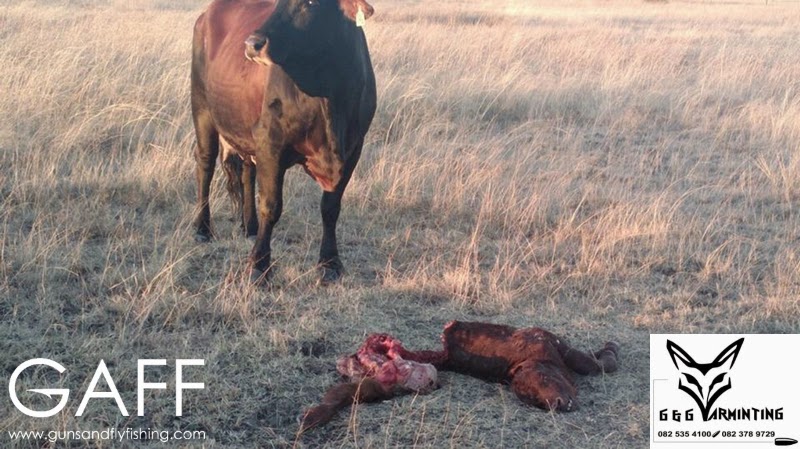
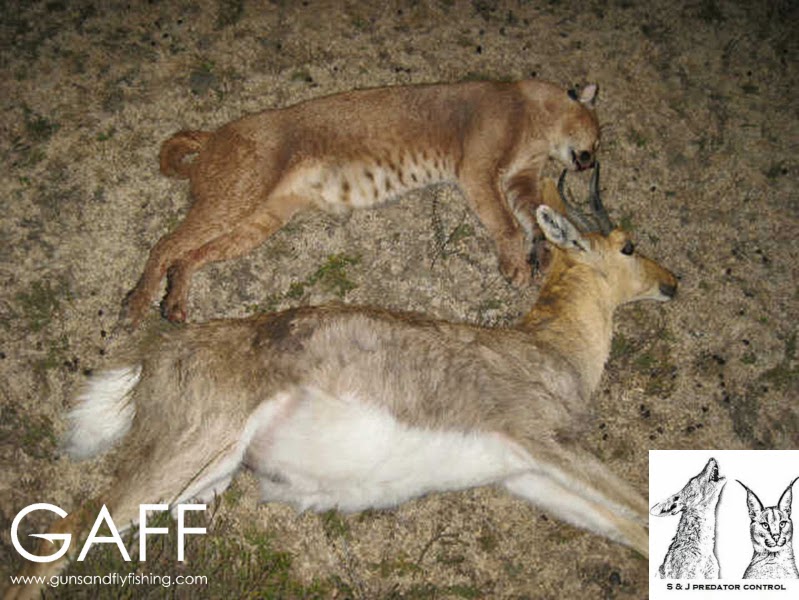
Disturbing images such as these are seen by game and livestock farmers on a daily basis:

Jaracal-Caracal-Hunting (1).jpg Jaracal-Caracal-Hunting (10).jpg

Now my intention is not to deliberately bad-mouth Black Backed Jackal and Caracal, as they do play an important part in the ecosystem, as all God’s living creatures do. They do have a role to fulfill in their natural habitat, as scavengers and by controlling vermin populations. Unfortunately Sheep (and especially Lambs) are an easier and softer target for a Black Backed Jackal that to kill than a Hare for instance. The other problem is that they do not necessarily kill and consume one lamb but they will kill a number of them and not utilize all of the carcasses.

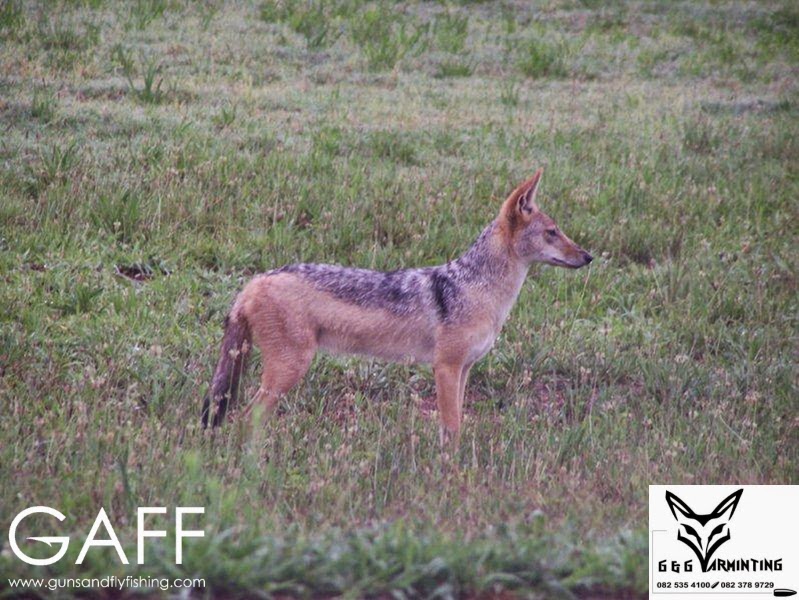
The Black Backed JackalCanis Mesomelas

Jackal have an average shoulder height of 45cm and adults can weigh anything between 6-14kg. Jackal are mostly nocturnal in areas where they kill livestock but in some reserves, they can be diurnal as well. Jackal are omnivorous creatures, with their diet consisting of birds, reptiles, carrion, berries, mammals and the reason we hunt them; livestock.

They form pairs that mate for life, unless one dies then the other will take on a new mate. When 2 Jackal pair up, they will establish a home territory. They will defend this to the death. In this territory, they will mark the area with urine and also with their scat along certain points. They also mark the territory vocally by making territorial howls and barks. In this area will be food, water and suitable cover.

Jaracal-Caracal-Hunting (6).jpg

When you see a Jackal during daytime the chances are good that you are in its home territory. This is an excellent area to call for them during night time. A pair of Jackal will start preparing to mate in April of each year. We do not normally start off with a Jackal call when hunting them at this time of year, but rather food calls such as: Rabbits, Steenbok and other small animals. This carries on to the end of July when the pups arrive after 61days of gestation.

Jackal give birth to 1 to 6 pups, but as many as 8 have been recorded. When the pups arrive, it gets easier to call in the Jackal. We then use their protective instinct against them. Sounds that work well are food calls, single Jackal calls and distress sounds of pups. We always try to kill the parents first, and then we dispatch of the pups. Both parents help rear the pups and they visit the dens regularly. They also carry food to the dens, where they regurgitate it in order to feed the pups.

Jaracal-Caracal-Hunting (7).jpg

From mid-November through to February/March is when you target the younger Jackal. In this time, the pups are running around, exploring, learning to hunt, and cause havoc with stock, as they generally catch and injure but don’t necessarily kill Sheep. We start off with social Jackal calls and 9 times out of 10, the young ones react. We also use fight and distress calls to utilize their curiosity instinct.

Around January/February, they get the distinctive black saddle on their coats from where the name Black Backed Jackal comes from.

The CaracalCaracal Caracal

Also known as “Rooikat” or Lynx, this beautiful cat can cause major damage to live stock and game animals. They stand about 50cm high, and can weigh up to 27kg in extreme cases. 1 to 3 kittens are born after a gestation period of around 80 days. Caracal have large territories and they lead a nomadic lifestyle. They are exceptionally strong animals, with a medium sized Caracal being capable of catching a Mountain Reedbuck without any difficulty.

caraca.jpg

They occupy rocky and dense, bushy areas. Young Caracal walk with their mother for a very long time, so if you shoot a female Caracal, just look around for her young. The chances are good that they will be in the vicinity of where the mother was spotted. Caracal respond very well to raspy sounds suck as Springhare, Scrubhare, and Jack Rabbit distress calls. The “Kiss of death” call also works well. It’s a kissing sound that you make with your lips, similar to when you call a dog.

They are relatively easy to shoot when you can spot them with a light at night time. Keep the light on them and drive towards them until you get inside shooting distance and take the shot. If you come across an animal killed by a Caracal have a look to see if the animal’s carcass has been covered with sand and grass. It’s a tell-tale sign that the Caracal will return to feed at a later stage. Wait from late afternoon for the Caracal to return to feed again, and then shoot it.

Equipment

To be efficient and successful, you need the following equipment as a bare minimum:

1. A reliable truck (bakkie).

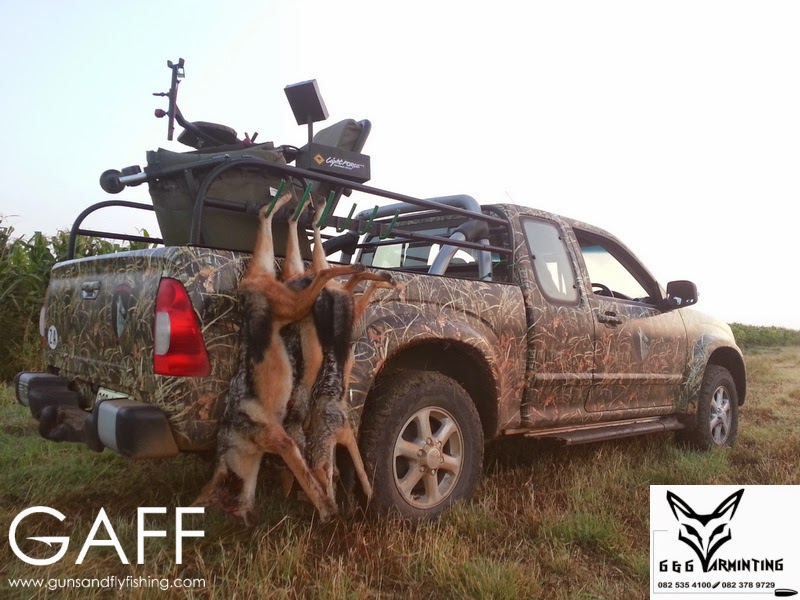
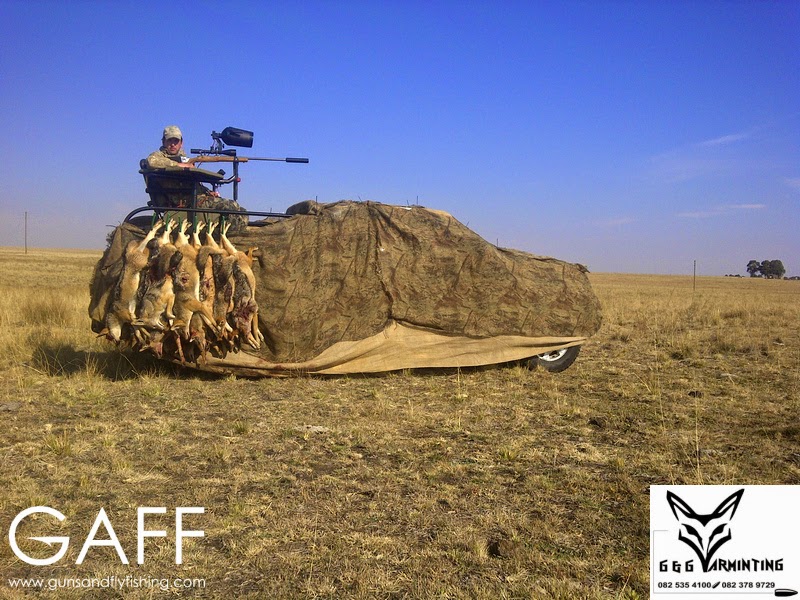
2. Hessian or camo netting to cover your bakkie, especially if it’s white (we use vinyl wrapped trucks nowadays).

Jaracal-Caracal-Hunting (4).jpg

3. Paint colours of a vehicle (if no netting is used) that work well are: Black, red, green, blue, sand, brown.

4. A rotating shooting chair or shooting frame. Chairs can be built by one self, or commercially manufactured chairs can be bought.

5. A proper shooting light fitted with a dimmer (not a red filter) as well as a handheld spotlight. I use a Lightforce 170RMSM fitted with a dimmer: http://www.lightforce.com/products/p…ntedspotlights

6. Remote callers such as: Foxpro (any model), Western Rivers, Tewis Van Oudshoorn, Cass Creek and the like. Personally, I believe Foxpro is the best for calling Jackal and Caracal.

7. Mouth calls like Critr’ call, Foxpro Skyote, Foxpro Keychain, Johnny Stewart, Primos work very well when used correctly.

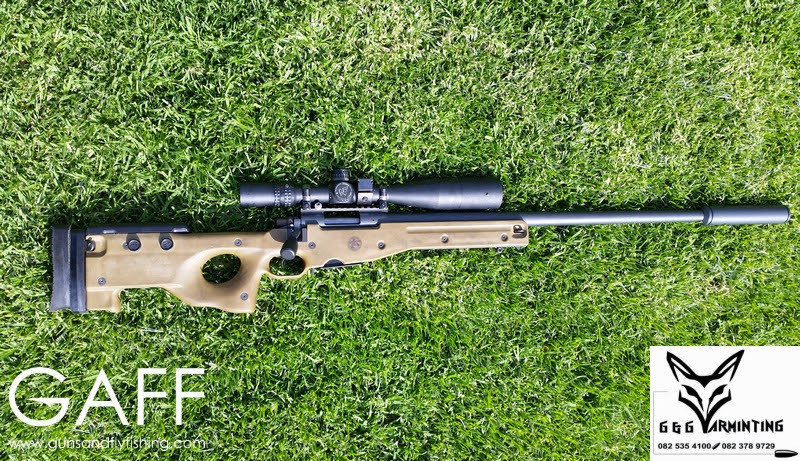
8. A rifle shooting varmint bullets at a minimum of 3300fps and preferably 3500fps and above.

Popular calibers are:

.223 (Rem and Ackley improved)
.243 (Win and Ackley Improved)
.25-06
.22-250
.220 Swift
6mm Dasher
6mm BR (and BRX)
.204 Ruger

Jaracal-Caracal-Hunting (9).jpg

I use a custom built 6mm Dasher with 55gr Nosler Ballistic Tips at 4000fps, a Ruger M77MKII VT in .25-06 Rem with 75gr Hornady V-Max bullets at 3700fps and a Howa 1500 Hogue in .204 Ruger that shoots 32gr Hornady V-Max and Nosler Varmageddon bullets at 3870fps.

9. A rifle scope with at least 8x magnification and 44mm objective diameter. We at G&G Varminting recently started using March optics (2.5-25×52).
Other good optics are: Zeiss, Diavari, Swarovski, Meopta and Schmidt & Bender.

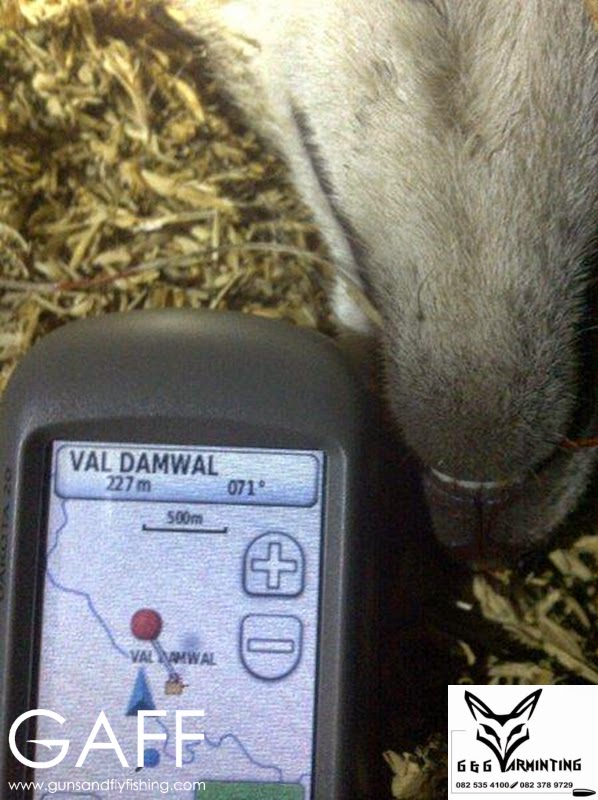
10. A handheld GPS to plot stands, dead Jackal, dens, water and to use bearings to get to Jackal that react to calls.

Jaracal-Caracal-Hunting 11 (2).jpg

Stand setup and Tactics

One can easily make 6-8 stands per night. Firstly, you need to know whether or not there are any Jackal in the area you decide to hunt in.

Core-territories are usually the following areas:

– Where Jackal are seen in daytime.
– High ground.
– Close (within 1km) of water.
– Where tracks that go both ways are seen.
– Where Jackal call late afternoon and early morning.

Jaracal-Caracal-Hunting (3).jpg

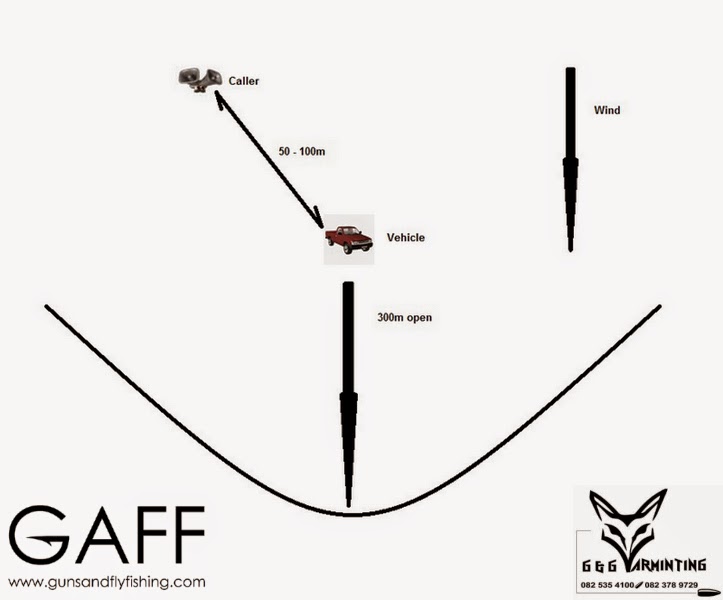
These are very good areas to set up a stand. Find a high spot with a 300m undisturbed view downwind, then you are in business. Dead ground, gullies, treelines etc. are things you definitely don’t want down-wind of you. A Jackal will smell you and associate you with danger.

A good friend and full time Jackal hunter, Taffie Muller has a saying: “a Jackal’s classroom is 450m downwind!” If you want to turn a dumb Jackal into an educated Jackal, then allow them to smell you.

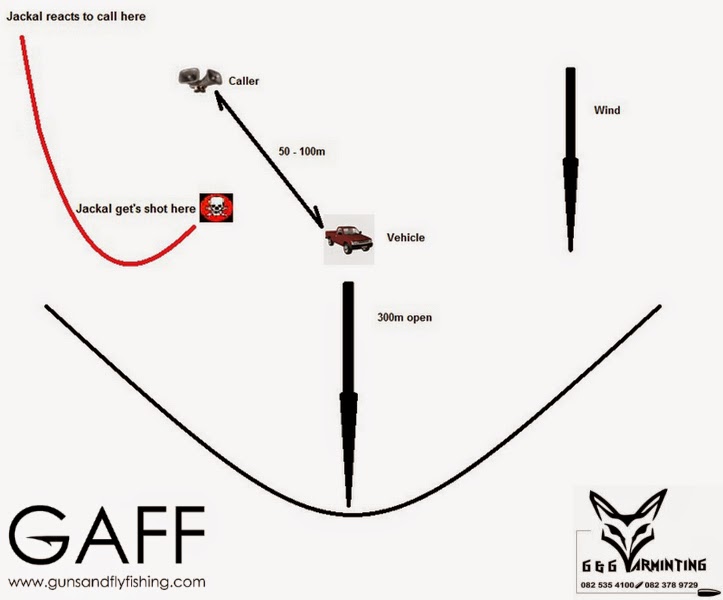
This is what the ideal stand layout looks like:

Jaracal-Caracal-Hunting (2).jpg

A Jackal will typically come in, and work around the caller, trying to get down-wind of it.

The following image shows why we put the caller diagonally into the wind:

Jaracal-Caracal-Hunting (8).jpg

This gets the Jackal nice and close for an easy shot. Red line is the Jackal’s approach.

Jaracal-Caracal-Hunting (5).jpg

If you have any problems with Jackal or Caracal killing your game or livestock, please do not hesitate to give G&G Varminting a call:

Geno Van Niekerk – 082 535 4100
geno@ggvarminting.co.za

© 2015 Guns and Fly Fishing. All Rights Reserved.
Fly Fishing for Largemouth Yellowfish

By Luka Geertsema

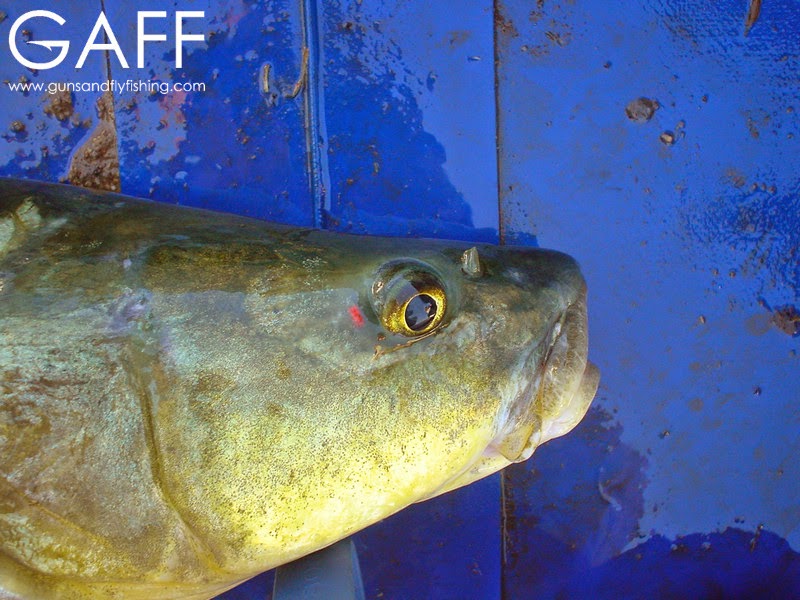
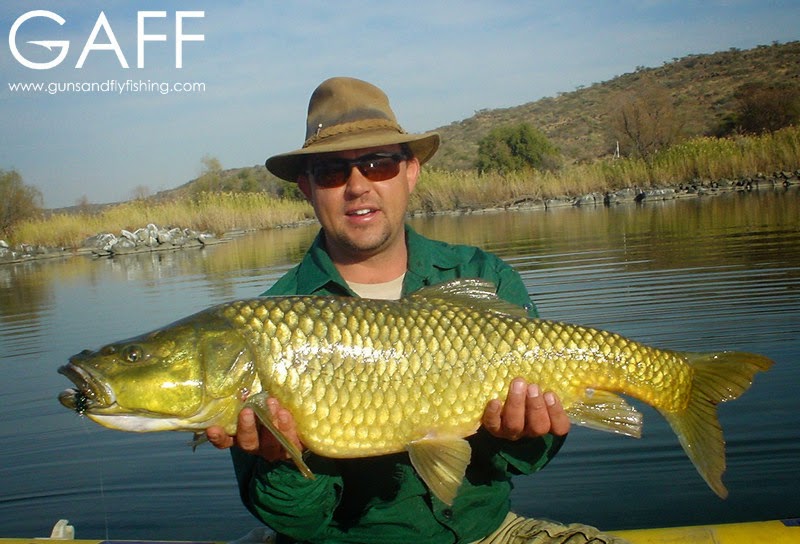
My favourite South African freshwater species to target on fly is without a doubt the Smallmouth Yellowfish. But the most challenging and rewarding freshwater fish for me on fly is the Largemouth Yellowfish. Largies are stealthy hunters and can be difficult to catch on fly. They live in water that is hard to get to and they put up a very brave fight. To target Largies, you have to understand how largies hunt and feed.

Although these fish will also scavenge for food by picking up crabs and other available food from the bottom, they are predominantly ambush predators, especially the larger specimens. In order for a fly fisherman to catch one of these magnificent creatures on fly, it is vital that to fully comprehend their ambush techniques and feeding behaviour. When targeting these fish you have to think like the ambush predator that it is. Similar to Largemouth Bass, their strategy involves ambushing baitfish, dragonflies, freshwater shrimp and amphibians.

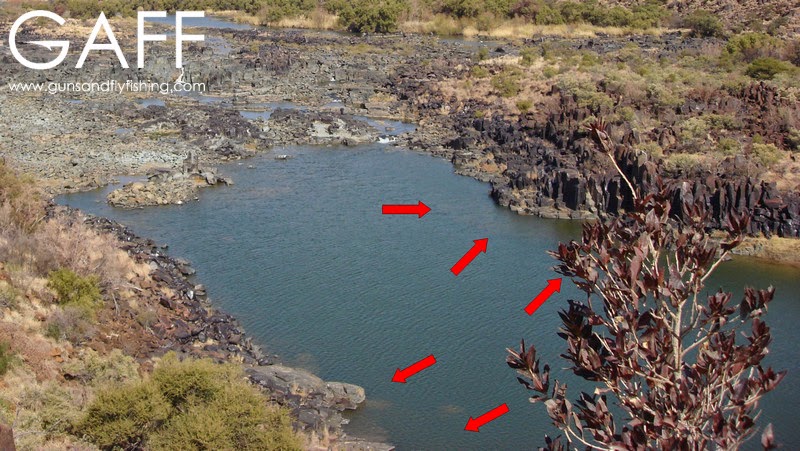
Largies prefer water with ample structure and some depth. I have found the best structure to find them in and around includes some kind of cover such as vegetation of some sort where small baitfish and other prey can hide. The Largemouth Yellow will usually position itself in such an area, ready to strike as soon as something like herons or catfish disturb the baitfish, causing them to scatter from the cover and making them vulnerable to other lurking predators.

Largemouth-Yellowfish-Fly-Fishing (7).jpg

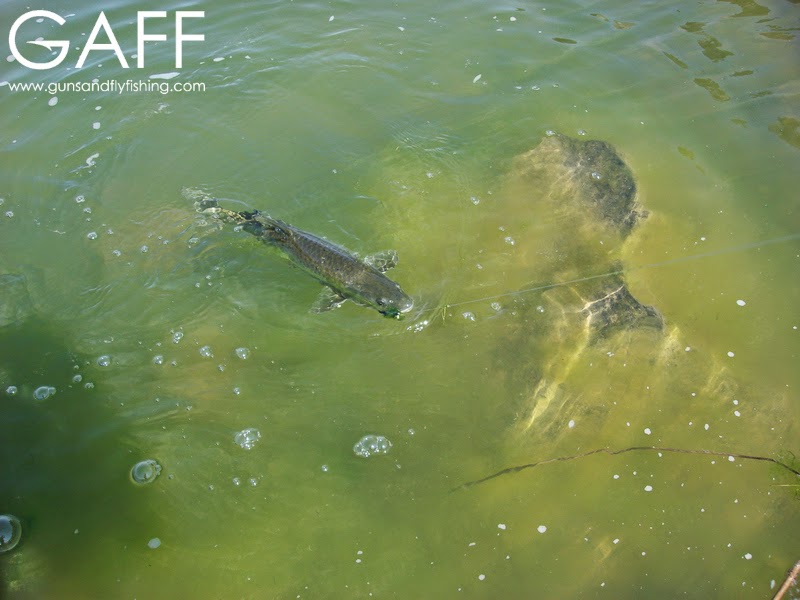
Another thing to remember is that Largies don’t have teeth and therefore they have to suck in their prey. For this specific reason many strikes are missed as the takes are sometimes very subtle. Clear water is essential for hunting Largies as they rely mainly on sight to locate prey. Their eyes face forward and upwards which suggests that they prefer hunting from deeper water, targeting their prey above and ahead of them. We have also noted that deeper water generally yield the larger fish. This is sometimes referred to as the aquarium effect.

On the Vaal River we prefer to target Largies during the winter months and mainly because of two reasons. Colder water carries more oxygen and results in the fish being more active. The second reason is that the water clarity of the Vaal River is better at the end of winter which is as previously mentioned, key in order to target them.

Largemouth-Yellowfish-Fly-Fishing (1).jpg

In order to successfully target Largemouth Yellowfish on fly, you preferably need a small inflatable boat equipped with a trolling motor and fish finder. This ensures not only that you can find the fish but also that you can approach any potential structure from a distance wich reduces the possibility of spooking any fish present in the area.

The first step would be to cast toward the bank or any other identified structure. Get your fly as close to the structure as possible (rocks, trees, logs etc.), let the fly sink to the desired depth and start strip-retrieving. Retrieving must be very slow but you can play around with the movement of the fly in order to imitate the swimming action of baitfish.

Largemouth-Yellowfish-Fly-Fishing (5).jpg Largemouth-Yellowfish-Fly-Fishing (6).jpg

Long and accurate casts are critical, especially so when the water visibility is more than 3 feet. Our usual setup would consist of at least 6/7wt rods, quality large arbour reels with a decent drag system and loaded with either a sinking or an intermediate line. There is a lot of information and suggestions about Largie flies out there, but any fly which can imitate a swimming action, is 1 to 2 inches in length and is tied in a darker colour will work; even more so if placed in the right spot and retrieved correctly.

Largemouth-Yellowfish-Fly-Fishing (3).jpg Largemouth-Yellowfish-Fly-Fishing (4).jpg

Remember to rather use heavier gear than being under-gunned for Largemouth Yellowfish. With lighter gear you will exhaust the fish past the point of recovery and off course, catch and release is non-negotiable with Largemouth Yellowfish. Every Largemouth Yellowfish that is caught, MUST BE RELEASED!

I have been catching Largies on fly for many years with my good old friend Jan-Harm Vorster from Kimberley, who has made thousands upon thousands of casts whilst targeting Largemouth Yellowfish. As well as being an active member of the Yellowfish Working Group (which promulgates catch and release of all Barbus species) Jan-Harm is also a registered tag and release angler and he has tagged hundreds of fish over the years in the Vaal River. He has guided many anglers in the Northern Cape for Largies and he has contributed more than most toward the conservation of our Yellowfish in South Africa.

When a tagged fish is caught please contact the YFWG and provide them with the date, place where the fish was caught, its weight, length (from fork in tail to tip of nose) as well as its girth measurement.

Largemouth-Yellowfish-Fly-Fishing (8).jpg

I have been blessed with this beautiful lady (tag no. Z99) of 8,1kg (17.85lbs) which I caught near Barkley West in the Northern Cape province of South Africa. It was truly an unforgettable moment when I released her back into the river and I saw her dissapearing into the depths.

Largemouth-Yellowfish-Fly-Fishing (2).jpg

Although development, agriculture and pollution is taking a toll on our Yellowfish population, there are still some monster Largies prowling our waters and if you put in the effort, spend time on the water and have a bit of luck on your side, you might catch one of these alpha predators on fly.

Good luck and tight lines.

© 2015 Guns and Fly Fishing. All Rights Reserved.
Hunting Black Wildebeest in South Africa

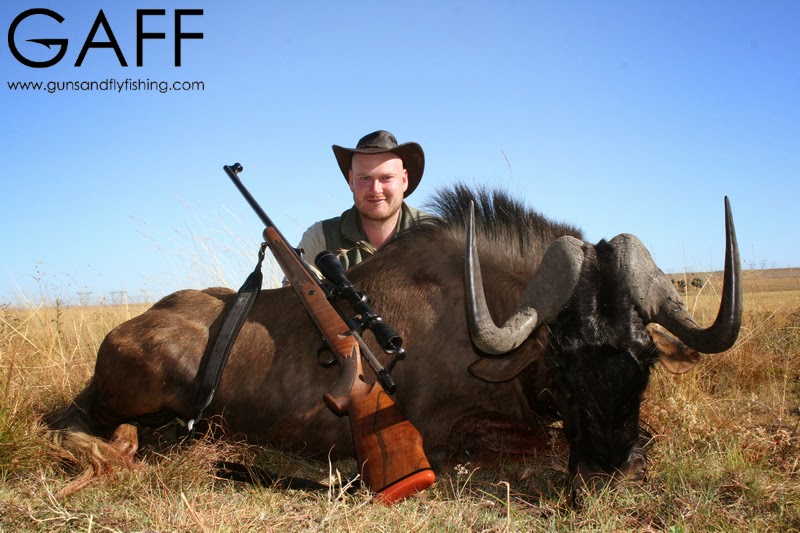
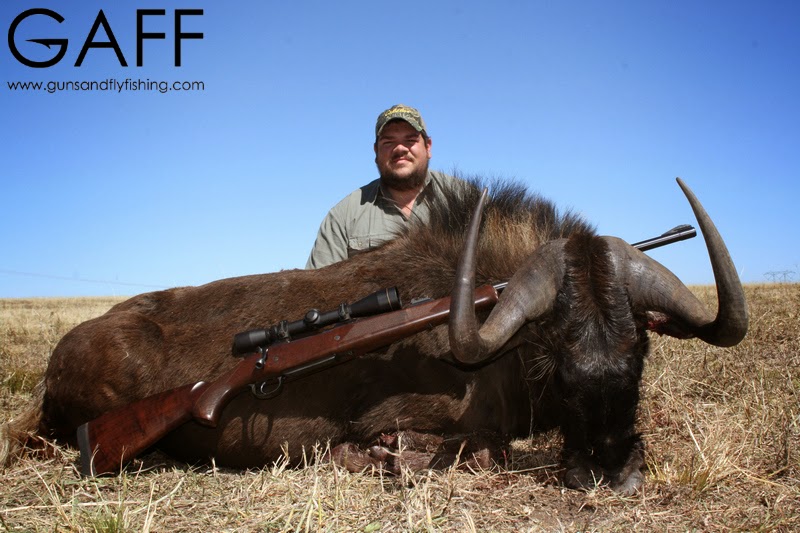
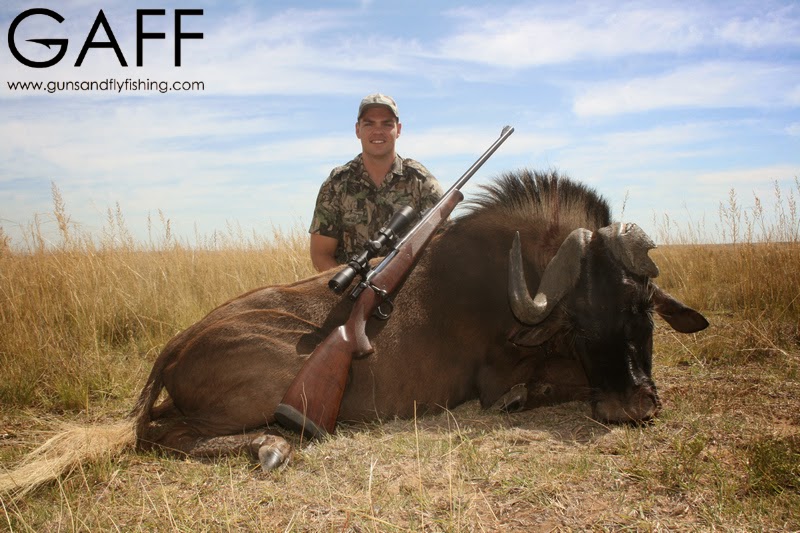
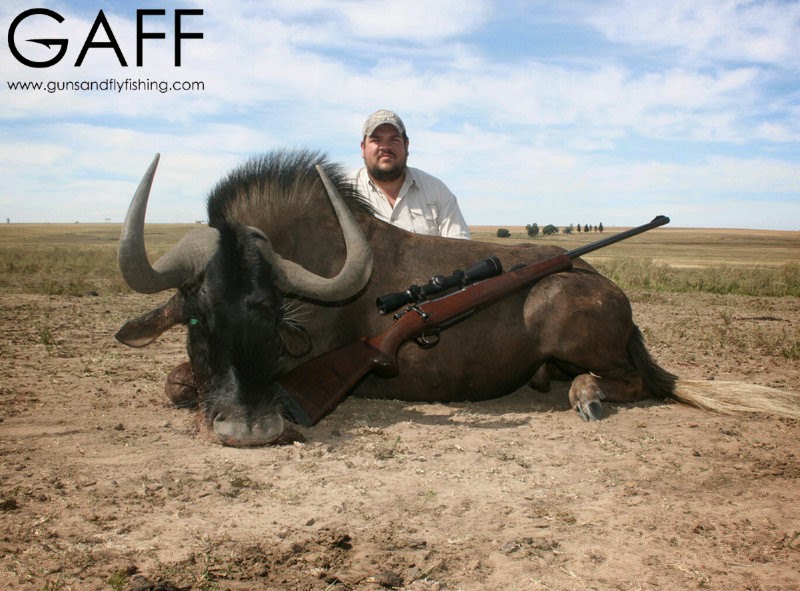
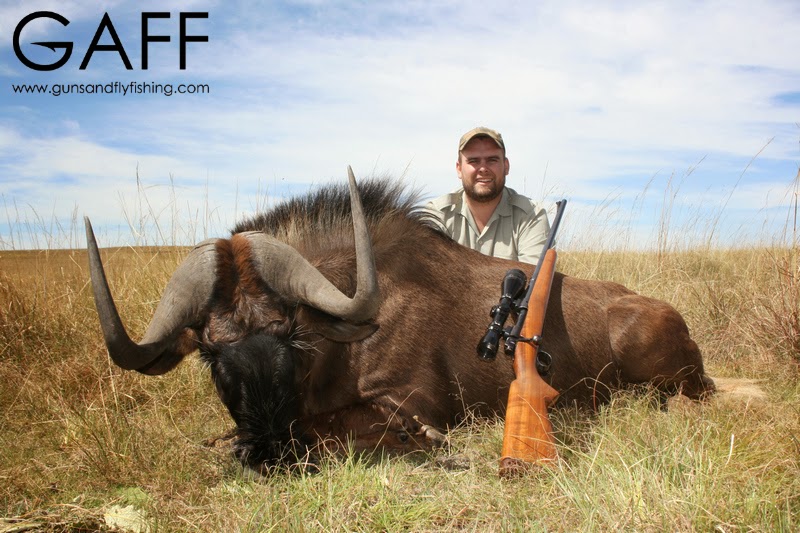
The Black Wildebeest (or White Tailed Gnu) is endemic to South Africa and is possibly one of the strangest looking antelope that you will encounter in South Africa. It is not as common as its cousin the Blue Wildebeest and they prefer grasslands and open plains to the bush. You will usually find them in the same habitat as Blesbuck, Eland and Springbuck where they can be found in big herds, grazing on short grass.

They can sometimes be quite comical in their behaviour and for those of you who have seen them running around in circles for no apparent reason; you’ll know why the Black Wildebeest is referred to by some as the “clown of the bush”. But don’t to let their comical appearance fool you, as they can reach a top speed of about 80km/h which makes them one of the fastest African antelope.

Black-Wildebeest-Hunting (5).jpg

Black Wildebeest have very long tails covered with white hair, which is similar in appearance to that of a horse. When hunting for a Trophy Black Wildebeest bull, an old trick of the trade is to look for the bull with the longest tail. If a Black Wildebeest bull’s tail is touching the ground, then it’s almost sure to measure for the record books (their Rowland Ward minimum is 22 7/8” and their SCI minimum is a score of 72). However crazy this might sound, it has been a well proven trick used by professional hunters and I have seen it with my own eyes on a number of occasions.

Black-Wildebeest-Hunting (1).jpg

They are not an easy animal to hunt, not only because of their blistering speed but also because of the habitat in which they are found. Wide open grassland plains or “Highveld” as its better known in South Africa, offer little to no cover at all for the hunter stalking on foot, which makes Black Wildebeest very challenging to hunt. It is not impossible to hunt them on foot, and it is still the preferred method to hunt these truly unique animals, from a fair chase point of view and where possible.

Black-Wildebeest-Hunting (4).jpg

Most hunts for Black Wildebeest are conducted from a hunting vehicle in open terrain, and even then the average shots taken on these animals can be anywhere between 200m to 400m and more. It can be quite difficult to single out an individual animal in a herd as they can congregate in vast numbers and as both the bulls and the cows have horns, which makes their gender difficult to distinguish from a distance. The other problem with hunting them is getting them to stand still in order to take a shot.

Black-Wildebeest-Hunting (3).jpg

When hunting Black Wildebeest from a vehicle, the average window of opportunity to take a shot will be anything from 2 to 4 seconds on average before the animals in the herd will start to move around or run away. It is thus very important that you know your rifle well and that you are familiar with its caliber’s trajectory over longer ranges. It is also important that you have practised beforehand at these longer ranges to eliminate any chances of wounding an animal.

In areas where Black Wildebeest are frequently hunted from a hunting vehicle in open terrain, the animals can become suspicious of the hunting vehicle over time (especially white vehicles), associating it with danger, which is the reason that they don’t hang around for too long when they see a hunting vehicle approaching in the distance.

Black-Wildebeest-Hunting (2).jpg

You ideally want a 6.5 mm and larger rifle caliber with premium bullets and a flat trajectory to hunt these animals as most shots will be taken at long range. A 6mm caliber (such as a .243 Winchester) with a premium bullet of about 87 to 100gr should be considered the absolute minimum effective caliber to be used on these animals, but then shot placement is absolutely critical. A flat shooting 7mm or .308 caliber with a 150gr bullet would be the better and recommended choice for hunting Black Wildebeest.

Black Wildebeest are one of my favourite African antelope to hunt and they are still relatively affordable to hunt in some places. Their horns make for a great shoulder or skull mount (European mount) and they make for good eating too.

Black-Wildebeest-Hunting (6).jpg

I hope that you too will develop the same admiration and respect that I have for the “clown of the bush”.

© 2015 Guns and Fly Fishing. All Rights Reserved.
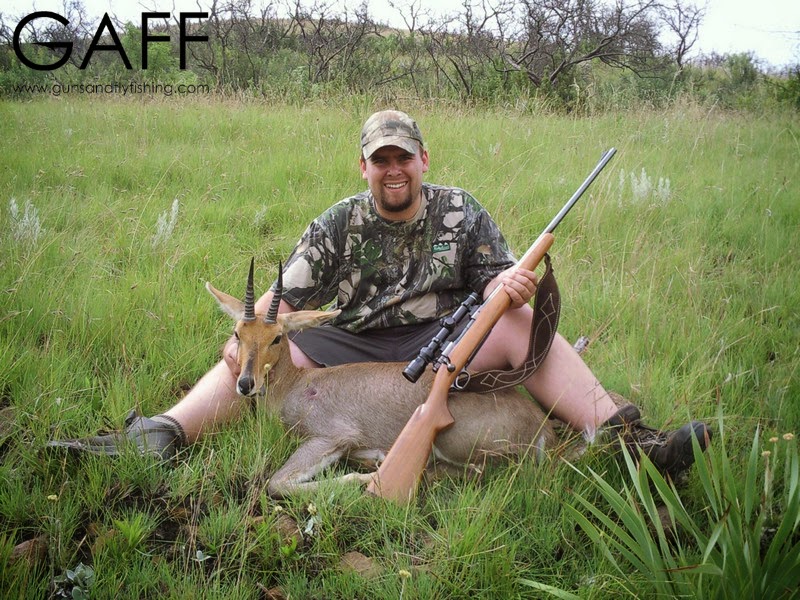
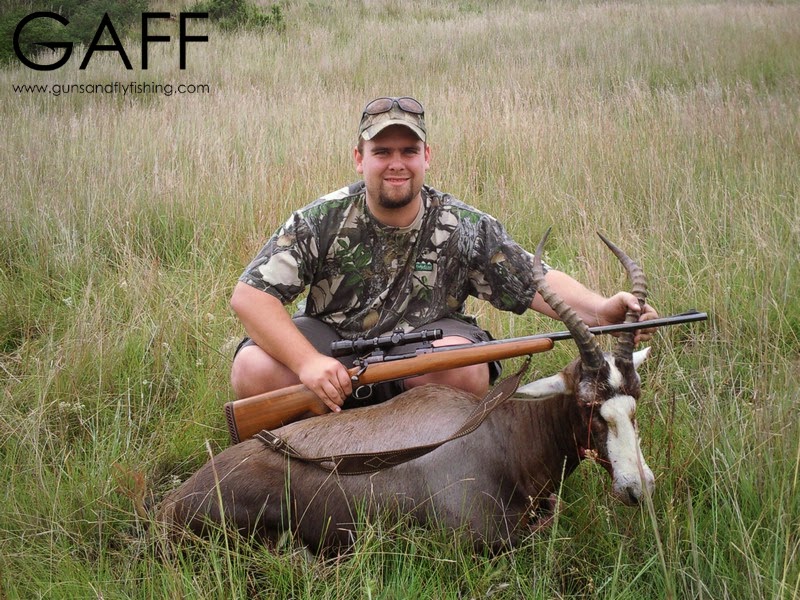
A Tale of Two Classics – M70 in 7×57 Mauser

By Edu Van Staden

I often reminisce about the rich history of my Pre 64 Winchester M70 chambered in 7×57 Mauser. This usually happens when I am cleaning it or when I am walking with it over my shoulder, somewhere in the African bush.

Conversations around the campfire usually end up on the subject of either which calibre is the perfect all round calibre or which calibre is best suited to which species of game. These conversations never come to a conclusion; and I although I have my own opinion on these subjects, I don’t believe that there is a specific right or wrong answer.

Taking on medium to large African plains game such as Impala or Blue Wildebeest with a .22 calibre rifle for instance, is just not sensible. You will only wound the animal, walk many kilometres on a poor blood spoor and at best the animal will die a slow and painful death. You will have blisters on your feet and you will have to pay the full price of the animal without even having a photo to show for it. For this reason there are recommendations and guidelines available in order to avoid these types of situations. With that being said, keep in mind that calibre does not make up for bad shot placement…

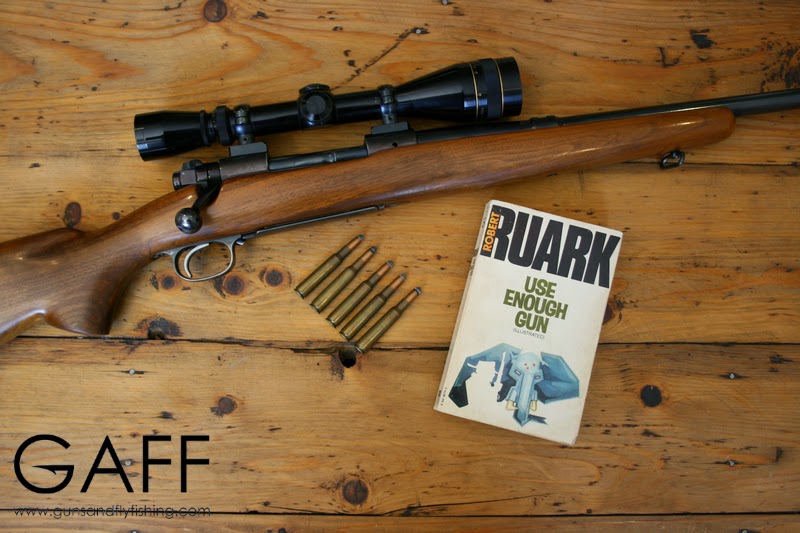
This always reminds me of a book I once read of the famous journalist and author Robert Ruark titled: “Use Enough Gun”.

7x57 mauser pre 64 m70 winchester (8).jpg

I often get asked why I hunt with a 7×57 Mauser when I could hunt with a more popular calibre such as a .308 Winchester? My answer then is sweet and short: “because I can”. It’s the same if I asked someone why they would hunt with a 9.3×62 Mauser and not with a .375 Holland & Holland, or why does someone hunt with a .404 Jeffery when they can use a .416 Rigby? The beauty of this is that it all boils down to personal choice. The best rifle and calibre for you is the one that you feel most comfortable with and that you have best confidence in.

The 7×57 Mauser is more than adequate for hunting the greater majority of African plains game today. Choosing the right premium bullet in the correct weight will ensure that it will be able to put down animals as large as Kudu and Blue Wildebeest. As always, shot placement is very important and is the key to success in the hunting field.

7x57 mauser pre 64 m70 winchester (7).jpg

The 7×57 Mauser was originally developed as a military cartridge in 1893 by a German with the name of Paul Mauser. It then was adopted by quite a few military forces around the world as their standard issue service rifle.

Here on home soil in South Africa the 7×57 Mauser made a good name for itself in the beginning of the 19th century, as it was used with great effect by the Boers against the English in the second Anglo-Boer war. In the beginning of the war the English had trouble infiltrating the old Transvaal as it was known back then. The reason for this being that at many a battlefield the masses of British troops received a big hiding from the Boers armed with their Mausers.

At the time, the British soldiers were armed with Lee-Metford and Lee-Enfield rifles chambered for the .303 British round. Back then the .303 British rounds were still loaded with cordite as a propellant and only later did they switch over to a smokeless powder. The Lee-Enfield however, could not match the Mauser’s accuracy and long range capabilities.

The Boers, armed with their Mausers, would start firing at the English from a distance of more than 1000 yards, often hitting their targets. This distance was just impossible for the English troops to return in fire with accuracy. The British Army had to rethink and revise their infiltration plans of the Transvaal and this all because of a 7×57 Mauser in the hands of the mighty Boer forces.

In the sporting field the 7×57 Mauser has been a well-known calibre for many years. The first name that comes to mind when thinking about the 7×57 Mauser in this regard, is that of the legendary ivory hunter Karomojo Bell. Karomojo successfully hunted in excess of 800 elephants using the 7×57 Mauser (also known as the .275 Rigby). He favoured this cartridge because of its low recoil and excellent penetrating characteristics.

7x57 mauser pre 64 m70 winchester (5).jpg

The 7×57 Mauser cartridge uses a very long projectile (compared to other cartridges) that gives it a high sectional density. Theoretically, the higher the sectional density of a bullet is the better its penetrating ability will be. Karomojo Bell sectioned an Elephants’ head and did a thorough study of the anatomy of the skull. This enabled him to place well aimed shots with his 7×57 in the animals’ brain resulting in instant death. However, I would not recommend this to anyone today (it would be both dangerous and illegal). I do believe that Bell was an extremely lucky man to not have been trampled by one of these great animals.

After many years of service in the military environment, the 7×57 Mauser became a very popular hunting cartridge across Europe, Africa and later America. Many rifle manufacturers started to chamber for the 7×57 Mauser to meet the demand of the hunting public. Even the legendary rifle makers of Rigby and Sons chambered for the 7×57 Mauser. Rigby called it the .275 Rigby, the reason for this being that they though the .275 Rigby name would be better suited for the American market that that of 7x57mm Mauser. Winchester also started chambering rifles for the 7×57 Mauser and it is one of these classic Pre 64 M70 rifles that I am lucky enough to own today.

7x57 mauser pre 64 m70 winchester (4).jpg

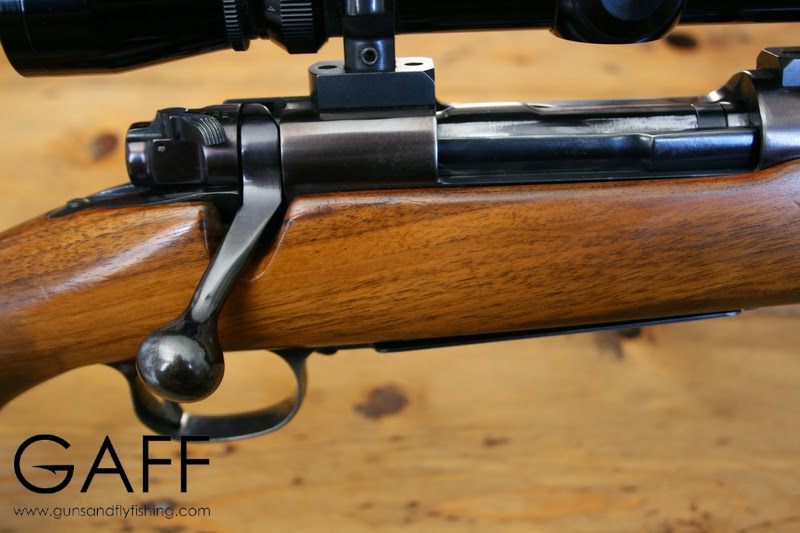
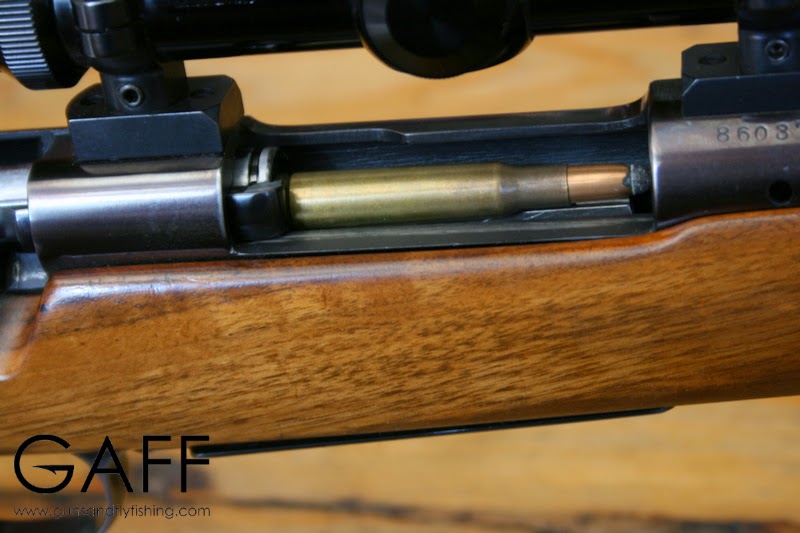
The Pre 64 Winchester Model 70 action was manufactured from 1937 up until 1964. It is one the finest bolt actions ever produced and it has one of the smoothest controlled feed actions ever manufactured. It has a cult status amongst fire-arm aficionados and has earned the nickname as “The Rifleman’s Rifle” due to its legendary popularity.

Winchester made a copy of the well-known German K98 Mauser action. They however made a few alterations and added a 3 position safety to the action. When the safety is on its first notch you can still cycle the action but the firing pin is the disengaged. When the safety is pulled back another notch it completely locks the action and the bolt cannot be cycled. Winchester most probably produced smoothest controlled feed action in the world with the development of the Pre 64 M70.

7x57 mauser pre 64 m70 winchester (2).jpg

The M70 was so popular that they chambered for a big array of calibres. They were quite popular among big game hunters and professional hunters in Africa in calibres like the .375H&H and the .458 Win Mag. The reason for this was because of the reliability of the M70 action.

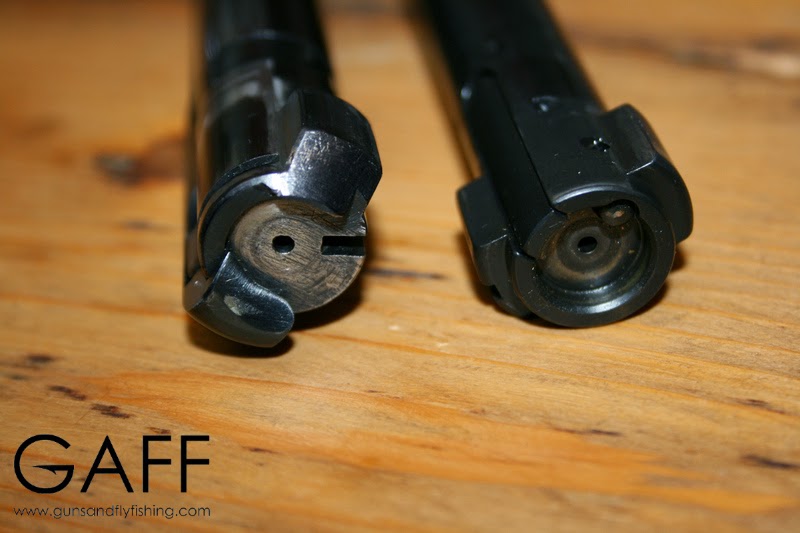
The big extractor claw on the bolt ensured dependable extraction of the spent cartridge case and the design of the action delivered a positive feed out of the magazine to push another round into the chamber. These are key components for a bolt action rifle when hunting dangerous game with big teeth and big tempers. Professional hunters and other sportsmen in Africa insisted on using Pre 64 M70 rifles as their back up rifle, because they were so reliable when hunting dangerous game.

7x57 mauser pre 64 m70 winchester (1).jpg

In 1964 however things changed. The labour cost of manufacturing the M70 rifles with the venerable controlled feed action was getting to high and the hunting public was not prepared to pay the inflated prices. Winchester then came up with a push-feed action for the M70 which cost far less to manufacture that the controlled feed action. The big Mauser type, non-rotating claw extractor was gone and it was replaced by a small extractor recessed in the bolt face.

7x57 mauser pre 64 m70 winchester (3).jpg

They introduced the “new” M70 rifles into the market but their sales did not increase. After some research they came to conclusion that the public did not want the “new” push-feed action in the M70 rifle. This was strange because at the time the M70 was competing with the popular Remington model 700 that was also a push-feed action. The reason was that the public were under the impression that the new M70 rifle’s push-feed action was inferior to that of the old and reliable controlled feed M70.

During this time Dakota introduced a bolt action rifle in the market that was similar to that of the original Pre 64 M70. This proved to be yet another nail in the coffin for Winchester.

In 1991 they decided to re-introduce the old Pre 64 action back into the market. But it was too late and the damage was done. Sadly, in 2006 the Winchester plant in New Haven closed their doors and the manufacturing of the M70 rifles ceased. FN Herstal, better known as Browning of Belgium, could not let the legendary M70 rifles fade into oblivion and so they took over the Winchester name and moved the factory to their own in California. They made minor changes to the design of the original Pre 64 M70 and in 2008 the rifles were re-introduced with the Pre 64 controlled feed action and again became available for the public under the original Winchester brand name.

My rifle is old one. The serial number dates back to 1948. Today in 2015 it still shoots sub MOA groups at 100m, and this with factory produced ammunition. I use it to hunt most of the plains game here in South Africa and I can honestly say that it is the most prized possession in my gun safe.

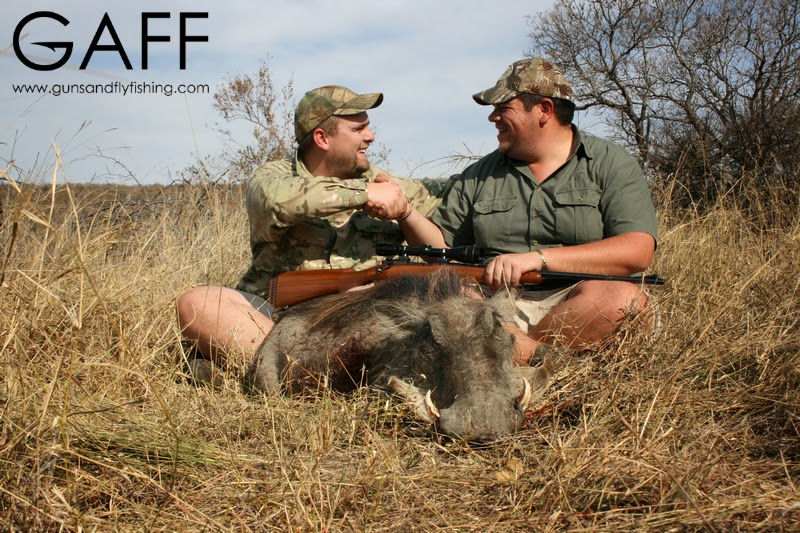
Friendships have been built because of this rifle and memories have been made which I will forever treasure. I wish that one day my grandson will be able to have the same admiration that I have for this rifle and that he too will be able to tell others about the tale of two classics.

7x57 mauser pre 64 m70 winchester (6).jpg

© 2015 Guns and Fly Fishing. All Rights Reserved.
Older posts

© 2026 Guns and Fly Fishing. All Rights Reserved.
Theme by Anders NorenModified by RooiWillie