Page 4 of 9

Hunting Black Wildebeest in South Africa

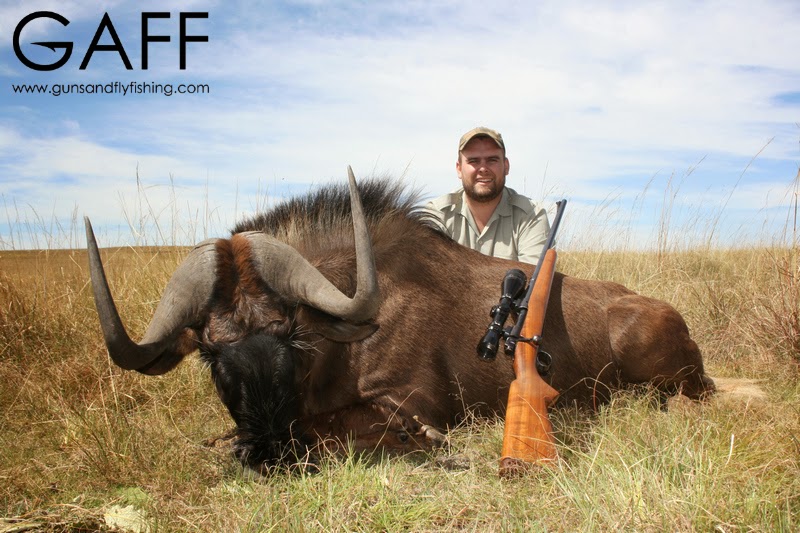
The Black Wildebeest (or White Tailed Gnu) is endemic to South Africa and is possibly one of the strangest looking antelope that you will encounter in South Africa. It is not as common as its cousin the Blue Wildebeest and they prefer grasslands and open plains to the bush. You will usually find them in the same habitat as Blesbuck, Eland and Springbuck where they can be found in big herds, grazing on short grass.

They can sometimes be quite comical in their behaviour and for those of you who have seen them running around in circles for no apparent reason; you’ll know why the Black Wildebeest is referred to by some as the “clown of the bush”. But don’t to let their comical appearance fool you, as they can reach a top speed of about 80km/h which makes them one of the fastest African antelope.
Black-Wildebeest-Hunting (5).jpg

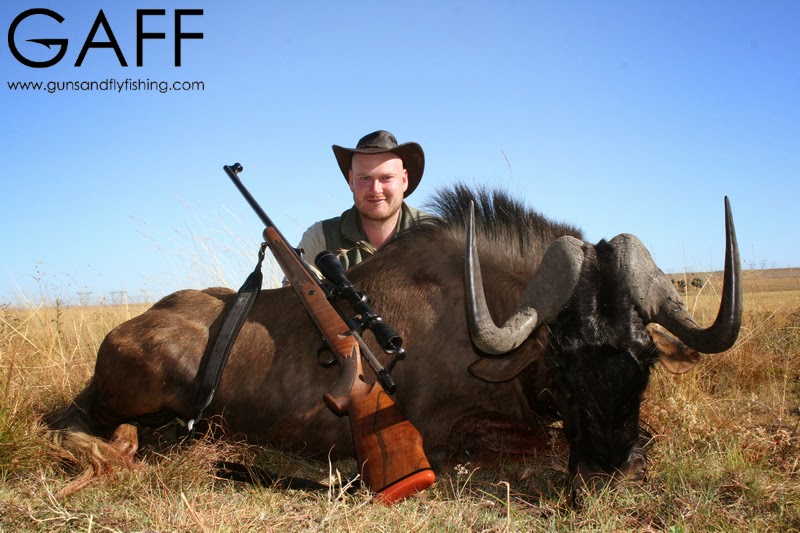
Black Wildebeest have very long tails covered with white hair, which is similar in appearance to that of a horse. When hunting for a Trophy Black Wildebeest bull, an old trick of the trade is to look for the bull with the longest tail. If a Black Wildebeest bull’s tail is touching the ground, then it’s almost sure to measure for the record books (their Rowland Ward minimum is 22 7/8” and their SCI minimum is a score of 72). However crazy this might sound, it has been a well proven trick used by professional hunters and I have seen it with my own eyes on a number of occasions.
Black-Wildebeest-Hunting (1).jpg

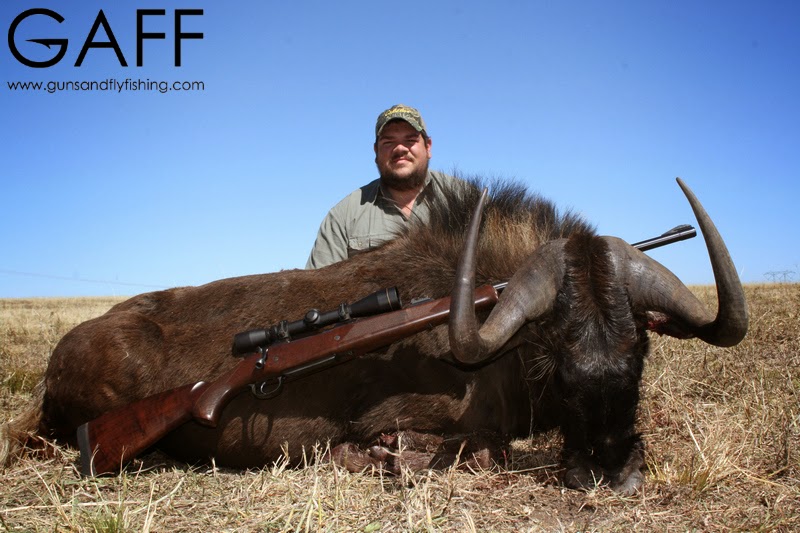
They are not an easy animal to hunt, not only because of their blistering speed but also because of the habitat in which they are found. Wide open grassland plains or “Highveld” as its better known in South Africa, offer little to no cover at all for the hunter stalking on foot, which makes Black Wildebeest very challenging to hunt. It is not impossible to hunt them on foot, and it is still the preferred method to hunt these truly unique animals, from a fair chase point of view and where possible.

Black-Wildebeest-Hunting (4).jpg

Most hunts for Black Wildebeest are conducted from a hunting vehicle in open terrain, and even then the average shots taken on these animals can be anywhere between 200m to 400m and more. It can be quite difficult to single out an individual animal in a herd as they can congregate in vast numbers and as both the bulls and the cows have horns, which makes their gender difficult to distinguish from a distance. The other problem with hunting them is getting them to stand still in order to take a shot.

Black-Wildebeest-Hunting (3).jpg

When hunting Black Wildebeest from a vehicle, the average window of opportunity to take a shot will be anything from 2 to 4 seconds on average before the animals in the herd will start to move around or run away. It is thus very important that you know your rifle well and that you are familiar with its caliber’s trajectory over longer ranges. It is also important that you have practised beforehand at these longer ranges to eliminate any chances of wounding an animal.

In areas where Black Wildebeest are frequently hunted from a hunting vehicle in open terrain, the animals can become suspicious of the hunting vehicle over time (especially white vehicles), associating it with danger, which is the reason that they don’t hang around for too long when they see a hunting vehicle approaching in the distance.
Black-Wildebeest-Hunting (2).jpg

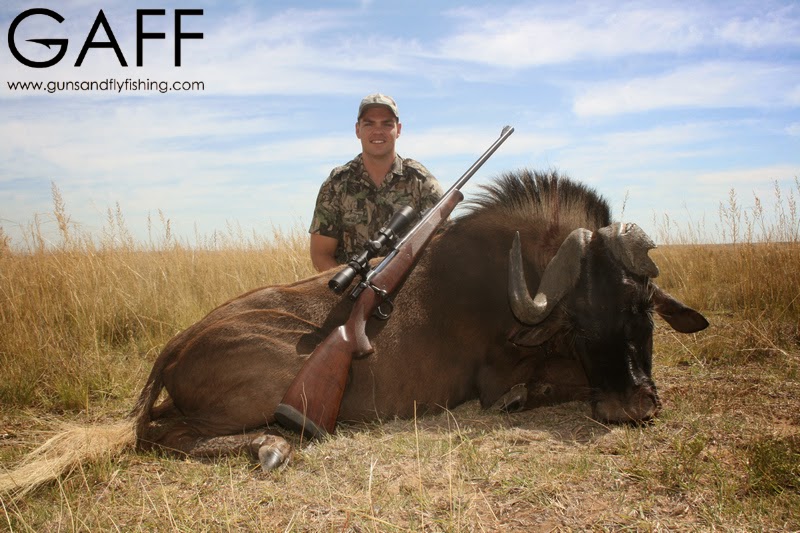
You ideally want a 6.5 mm and larger rifle caliber with premium bullets and a flat trajectory to hunt these animals as most shots will be taken at long range. A 6mm caliber (such as a .243 Winchester) with a premium bullet of about 87 to 100gr should be considered the absolute minimum effective caliber to be used on these animals, but then shot placement is absolutely critical. A flat shooting 7mm or .308 caliber with a 150gr bullet would be the better and recommended choice for hunting Black Wildebeest.

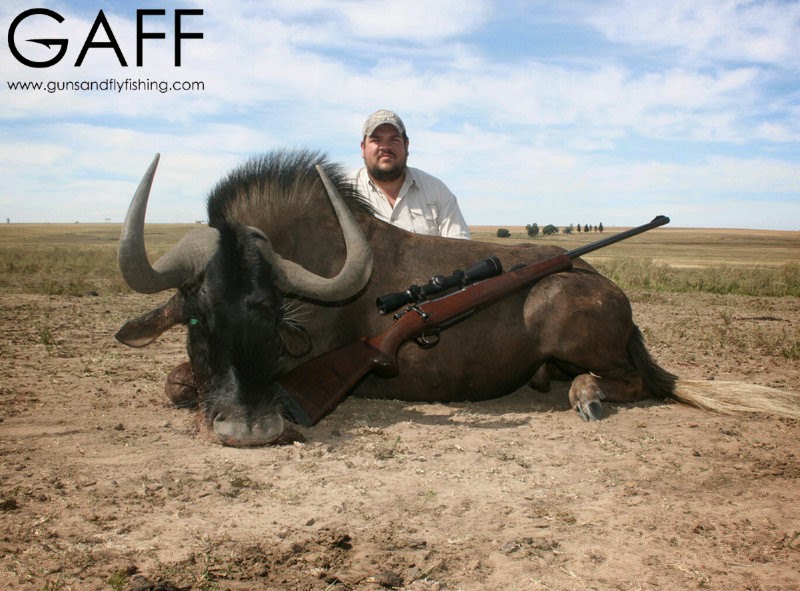
Black Wildebeest are one of my favourite African antelope to hunt and they are still relatively affordable to hunt in some places. Their horns make for a great shoulder or skull mount (European mount) and they make for good eating too.
Black-Wildebeest-Hunting (6).jpg

I hope that you too will develop the same admiration and respect that I have for the “clown of the bush”.

© 2015 Guns and Fly Fishing. All Rights Reserved.
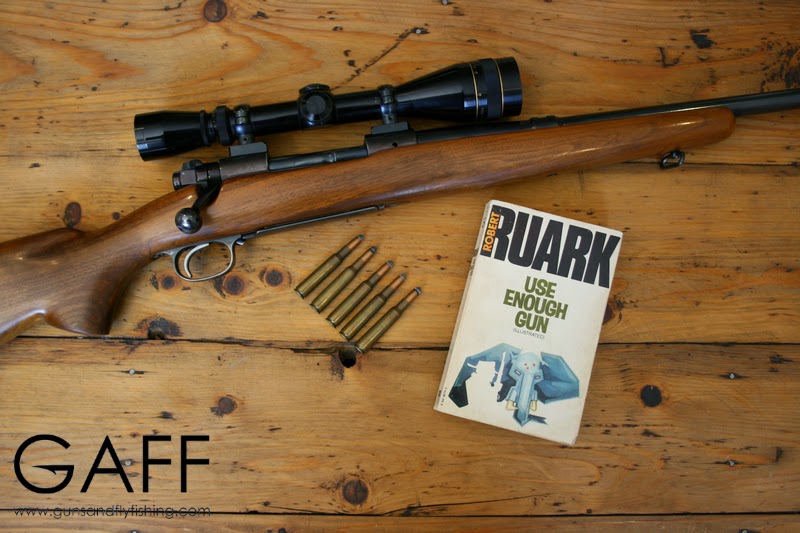
A Tale of Two Classics – M70 in 7×57 Mauser

By Edu Van Staden

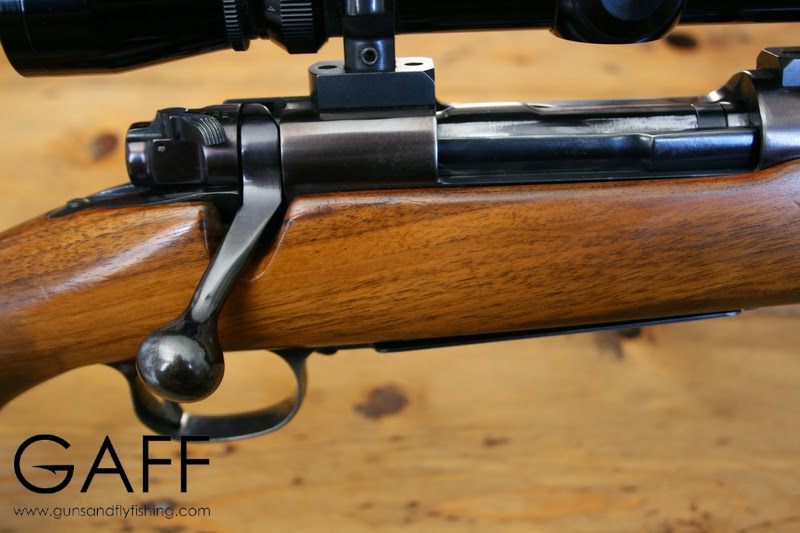
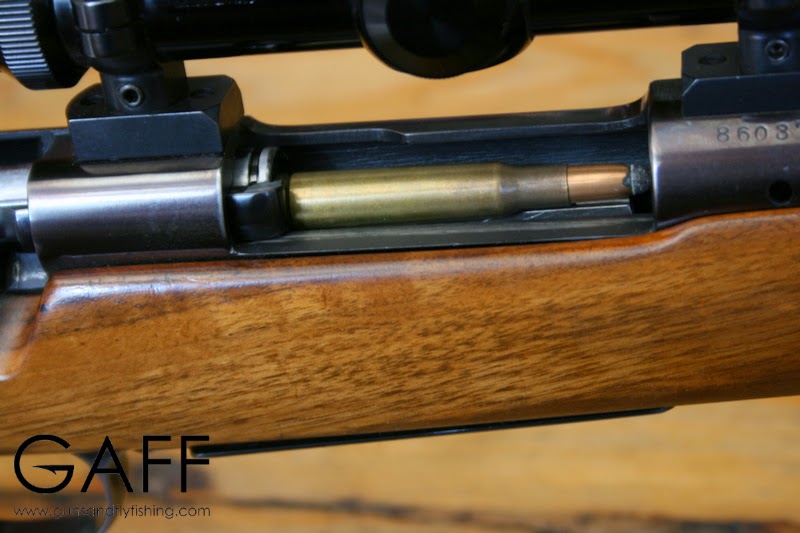
I often reminisce about the rich history of my Pre 64 Winchester M70 chambered in 7×57 Mauser. This usually happens when I am cleaning it or when I am walking with it over my shoulder, somewhere in the African bush.

Conversations around the campfire usually end up on the subject of either which calibre is the perfect all round calibre or which calibre is best suited to which species of game. These conversations never come to a conclusion; and I although I have my own opinion on these subjects, I don’t believe that there is a specific right or wrong answer.

Taking on medium to large African plains game such as Impala or Blue Wildebeest with a .22 calibre rifle for instance, is just not sensible. You will only wound the animal, walk many kilometres on a poor blood spoor and at best the animal will die a slow and painful death. You will have blisters on your feet and you will have to pay the full price of the animal without even having a photo to show for it. For this reason there are recommendations and guidelines available in order to avoid these types of situations. With that being said, keep in mind that calibre does not make up for bad shot placement…

This always reminds me of a book I once read of the famous journalist and author Robert Ruark titled: “Use Enough Gun”.

7x57 mauser pre 64 m70 winchester (8).jpg

I often get asked why I hunt with a 7×57 Mauser when I could hunt with a more popular calibre such as a .308 Winchester? My answer then is sweet and short: “because I can”. It’s the same if I asked someone why they would hunt with a 9.3×62 Mauser and not with a .375 Holland & Holland, or why does someone hunt with a .404 Jeffery when they can use a .416 Rigby? The beauty of this is that it all boils down to personal choice. The best rifle and calibre for you is the one that you feel most comfortable with and that you have best confidence in.

The 7×57 Mauser is more than adequate for hunting the greater majority of African plains game today. Choosing the right premium bullet in the correct weight will ensure that it will be able to put down animals as large as Kudu and Blue Wildebeest. As always, shot placement is very important and is the key to success in the hunting field.

7x57 mauser pre 64 m70 winchester (7).jpg

The 7×57 Mauser was originally developed as a military cartridge in 1893 by a German with the name of Paul Mauser. It then was adopted by quite a few military forces around the world as their standard issue service rifle.

Here on home soil in South Africa the 7×57 Mauser made a good name for itself in the beginning of the 19th century, as it was used with great effect by the Boers against the English in the second Anglo-Boer war. In the beginning of the war the English had trouble infiltrating the old Transvaal as it was known back then. The reason for this being that at many a battlefield the masses of British troops received a big hiding from the Boers armed with their Mausers.

At the time, the British soldiers were armed with Lee-Metford and Lee-Enfield rifles chambered for the .303 British round. Back then the .303 British rounds were still loaded with cordite as a propellant and only later did they switch over to a smokeless powder. The Lee-Enfield however, could not match the Mauser’s accuracy and long range capabilities.

The Boers, armed with their Mausers, would start firing at the English from a distance of more than 1000 yards, often hitting their targets. This distance was just impossible for the English troops to return in fire with accuracy. The British Army had to rethink and revise their infiltration plans of the Transvaal and this all because of a 7×57 Mauser in the hands of the mighty Boer forces.

In the sporting field the 7×57 Mauser has been a well-known calibre for many years. The first name that comes to mind when thinking about the 7×57 Mauser in this regard, is that of the legendary ivory hunter Karomojo Bell. Karomojo successfully hunted in excess of 800 elephants using the 7×57 Mauser (also known as the .275 Rigby). He favoured this cartridge because of its low recoil and excellent penetrating characteristics.

7x57 mauser pre 64 m70 winchester (5).jpg

The 7×57 Mauser cartridge uses a very long projectile (compared to other cartridges) that gives it a high sectional density. Theoretically, the higher the sectional density of a bullet is the better its penetrating ability will be. Karomojo Bell sectioned an Elephants’ head and did a thorough study of the anatomy of the skull. This enabled him to place well aimed shots with his 7×57 in the animals’ brain resulting in instant death. However, I would not recommend this to anyone today (it would be both dangerous and illegal). I do believe that Bell was an extremely lucky man to not have been trampled by one of these great animals.

After many years of service in the military environment, the 7×57 Mauser became a very popular hunting cartridge across Europe, Africa and later America. Many rifle manufacturers started to chamber for the 7×57 Mauser to meet the demand of the hunting public. Even the legendary rifle makers of Rigby and Sons chambered for the 7×57 Mauser. Rigby called it the .275 Rigby, the reason for this being that they though the .275 Rigby name would be better suited for the American market that that of 7x57mm Mauser. Winchester also started chambering rifles for the 7×57 Mauser and it is one of these classic Pre 64 M70 rifles that I am lucky enough to own today.

7x57 mauser pre 64 m70 winchester (4).jpg

The Pre 64 Winchester Model 70 action was manufactured from 1937 up until 1964. It is one the finest bolt actions ever produced and it has one of the smoothest controlled feed actions ever manufactured. It has a cult status amongst fire-arm aficionados and has earned the nickname as “The Rifleman’s Rifle” due to its legendary popularity.

Winchester made a copy of the well-known German K98 Mauser action. They however made a few alterations and added a 3 position safety to the action. When the safety is on its first notch you can still cycle the action but the firing pin is the disengaged. When the safety is pulled back another notch it completely locks the action and the bolt cannot be cycled. Winchester most probably produced smoothest controlled feed action in the world with the development of the Pre 64 M70.

7x57 mauser pre 64 m70 winchester (2).jpg

The M70 was so popular that they chambered for a big array of calibres. They were quite popular among big game hunters and professional hunters in Africa in calibres like the .375H&H and the .458 Win Mag. The reason for this was because of the reliability of the M70 action.

The big extractor claw on the bolt ensured dependable extraction of the spent cartridge case and the design of the action delivered a positive feed out of the magazine to push another round into the chamber. These are key components for a bolt action rifle when hunting dangerous game with big teeth and big tempers. Professional hunters and other sportsmen in Africa insisted on using Pre 64 M70 rifles as their back up rifle, because they were so reliable when hunting dangerous game.

7x57 mauser pre 64 m70 winchester (1).jpg

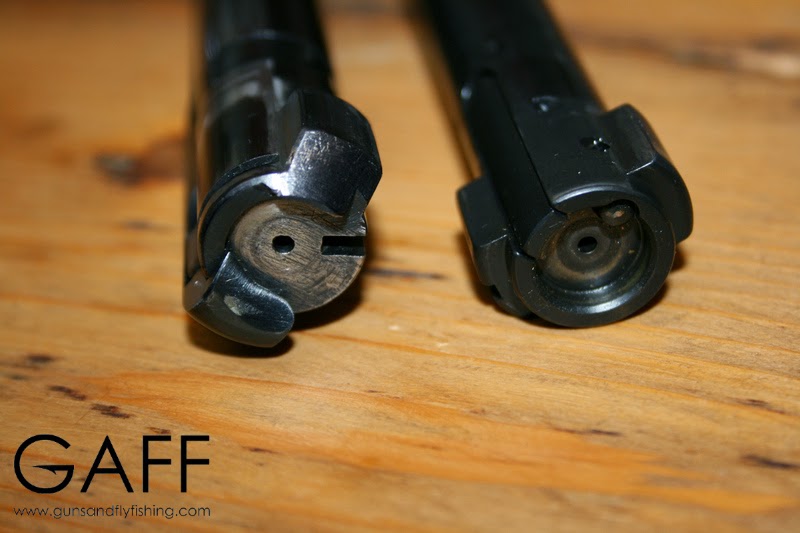
In 1964 however things changed. The labour cost of manufacturing the M70 rifles with the venerable controlled feed action was getting to high and the hunting public was not prepared to pay the inflated prices. Winchester then came up with a push-feed action for the M70 which cost far less to manufacture that the controlled feed action. The big Mauser type, non-rotating claw extractor was gone and it was replaced by a small extractor recessed in the bolt face.

7x57 mauser pre 64 m70 winchester (3).jpg

They introduced the “new” M70 rifles into the market but their sales did not increase. After some research they came to conclusion that the public did not want the “new” push-feed action in the M70 rifle. This was strange because at the time the M70 was competing with the popular Remington model 700 that was also a push-feed action. The reason was that the public were under the impression that the new M70 rifle’s push-feed action was inferior to that of the old and reliable controlled feed M70.

During this time Dakota introduced a bolt action rifle in the market that was similar to that of the original Pre 64 M70. This proved to be yet another nail in the coffin for Winchester.

In 1991 they decided to re-introduce the old Pre 64 action back into the market. But it was too late and the damage was done. Sadly, in 2006 the Winchester plant in New Haven closed their doors and the manufacturing of the M70 rifles ceased. FN Herstal, better known as Browning of Belgium, could not let the legendary M70 rifles fade into oblivion and so they took over the Winchester name and moved the factory to their own in California. They made minor changes to the design of the original Pre 64 M70 and in 2008 the rifles were re-introduced with the Pre 64 controlled feed action and again became available for the public under the original Winchester brand name.

My rifle is old one. The serial number dates back to 1948. Today in 2015 it still shoots sub MOA groups at 100m, and this with factory produced ammunition. I use it to hunt most of the plains game here in South Africa and I can honestly say that it is the most prized possession in my gun safe.

Friendships have been built because of this rifle and memories have been made which I will forever treasure. I wish that one day my grandson will be able to have the same admiration that I have for this rifle and that he too will be able to tell others about the tale of two classics.

7x57 mauser pre 64 m70 winchester (6).jpg

© 2015 Guns and Fly Fishing. All Rights Reserved.
Fly Fishing for Carp

By Jean-Paul Henin

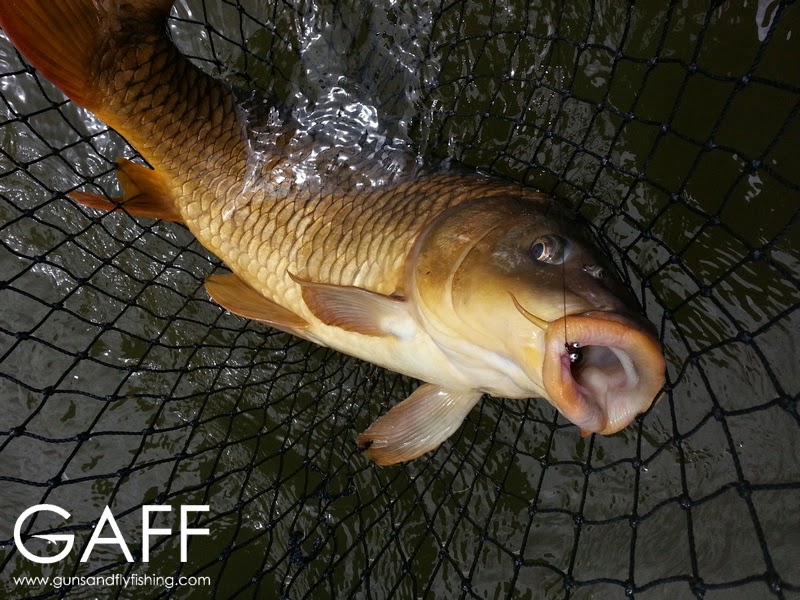
Some years ago a friend from work told me about a dam in Secunda, South Africa where you could target Carp and Sharptooth Catfish on fly right at your feet in the shallow water. I was very sceptical of his statement as I firmly believed that Carp only ate dough baits and earth worms. Imagine how surprised I was when I went with my friend to the dam I literally caught a Carp on fly with my first cast!

I still remember that the fish almost ripped my rod right out of my hand when it took the fly and it started stripping line of my reel like a runaway train. The fish was just over 8 pounds which was almost double the weight of my biggest Trout caught on fly at that stage.

Fly Fishing for Carp (1).jpg

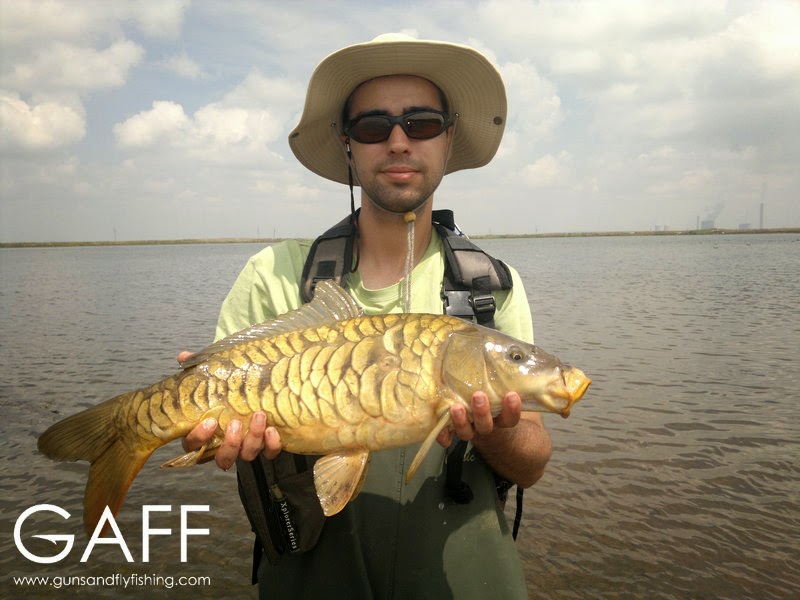
That was about 4 years ago and since then I have averaged approximately 100 of these magnificent fish a year, as I fly fish for them almost every day. I am very fortunate as I have access to various dams and ponds within 20 minutes of my home in Secunda, which is the town where I live.

Fly Fishing for Carp (5).jpg

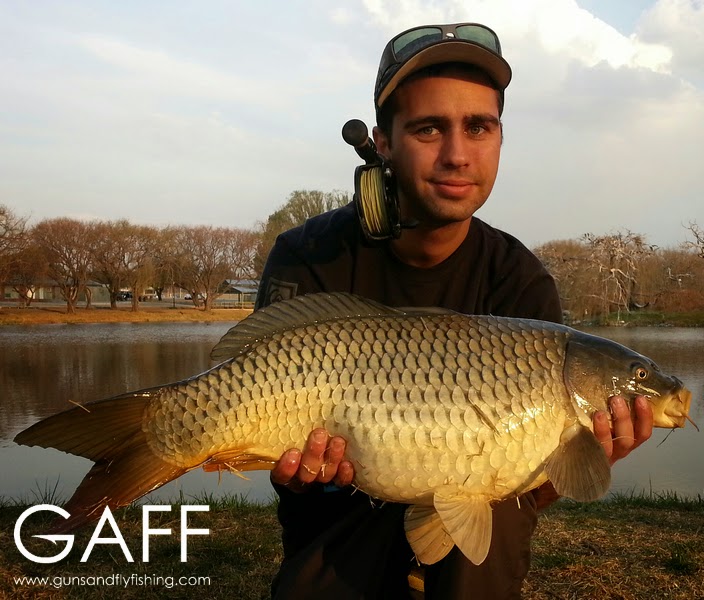
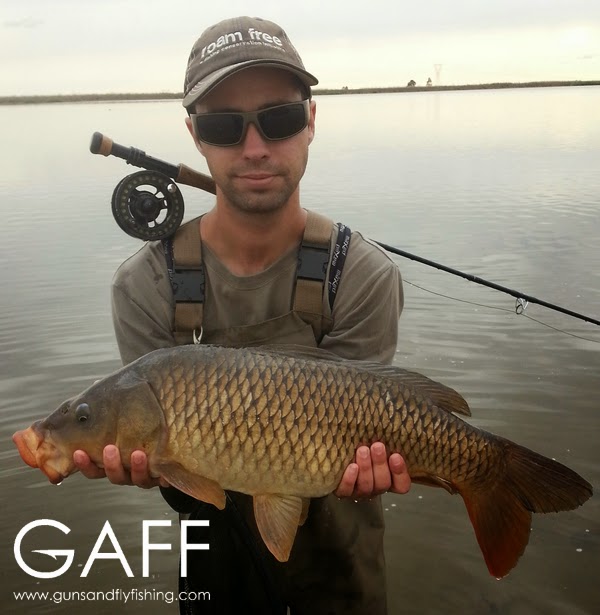
I have devoted a lot of time targeting Carp on fly and I have developed somewhat of an addiction for these incredibly wary and hard fighting fish. There are many people that believe Carp are a garbage fish and that they are not worthy of being targeted on fly, but once you have caught a 20 pounder on fly I promise you that you will have no more reservations about these amazing fish.

Many people have asked me for advice when it comes to catching Carp on fly, so I would like to share some of the tactics and techniques that have worked for me over the last couple of years.

Targeting Carp in clear water:

My leader setup is very simple, I use 12 feet of 14 lbs Berkley Vanish with a strike indicator. I prefer fluorocarbon over monofilament in clear water as the fish seem to spook less when using fluorocarbon material. My choice of indicator is the small polystyrene football shaped indicators that is fixed into position on the leader by means of using a toothpick. They are easily adjustable for different depths in seconds, which is an important factor when targeting Carp on fly.

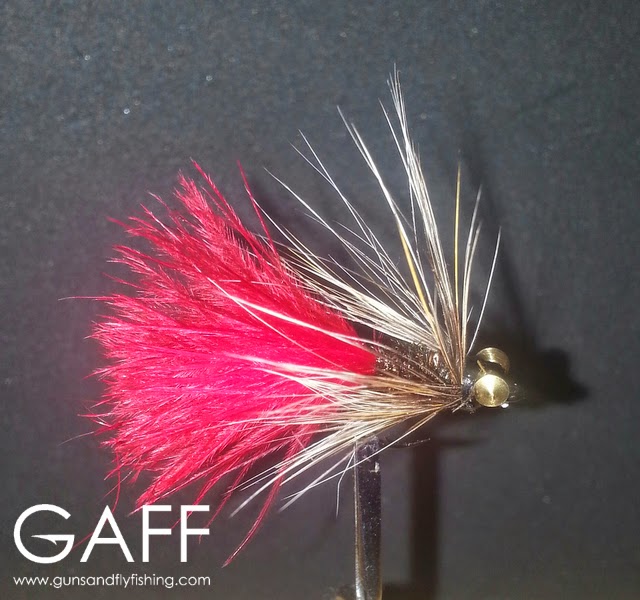
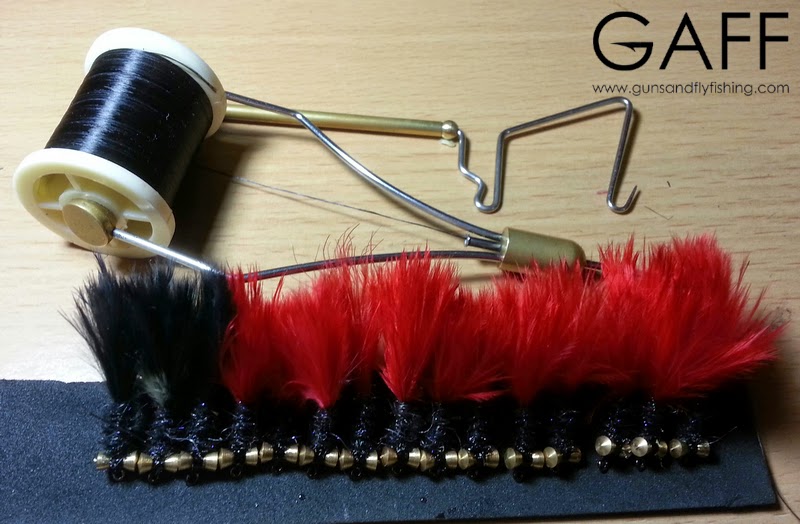
I prefer black Carp Buggers for clear water but have caught them on blood worm imitations, red & black coloured Woolly Buggers and red tailed Carp Buggers. Recommended hook sizes will be from #10 to #6 but I only use #8 lately.

Fly Fishing for Carp (7).jpg

Carp are not very selective feeders when feeding at the bottom from what I have seen. They will eat almost anything that is put in front of them, but they can also prove to be difficult to catch on certain days for no apparent reason.

When wading in shallow clear water for tailing Carp, the most important thing is to move as slow as possible, not to disturb the water as these fish are incredibly sensitive to movement. Cast a little ahead of the fish and drag the fly within 30 cm of its head. If the fish is moving but toward the fly but not eating it, give it a little twitch to try and entice the Carp to take it. I have had Carp chase my fly like a Bass after giving it a twitch.

If the Carp takes the fly, strip strike immediately. They tend to suck the fly in then blow it out upon realizing that it is not food. If the same fish still does not take the fly on offer, then nine times out of ten it’s time to move on and rather target another one.

Targeting Carp In muddy water:

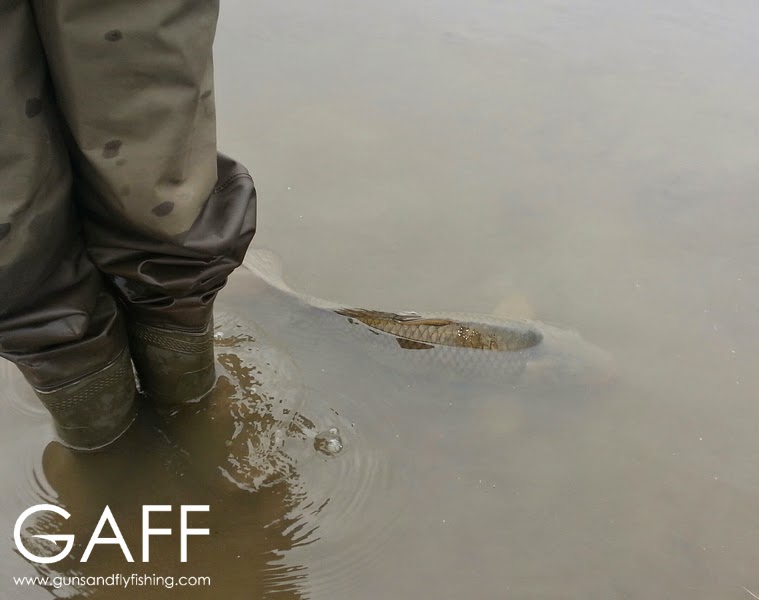
This is my favourite type of water and can be very challenging. I use the exact same set up here as I do for clear water but I only use one type of fly which is a #8 Carp bugger which I found have found to be very productive over the years. The only indication you have in muddy water of a feeding fish is bubbles. These bubbles will look like a kettle boiling on one spot and might move slowly. Cast ahead of the bubbles and drag the fly into the bubbles. It is very important that your fly is well weighted to get into the feeding zone as quick as possible.

carp fly.jpg

The indicator must also be set to about one and a half times the depth you are fishing, to ensure that the fly gets down to the bottom where the Carp are feeding. The takes on the bottom are mostly of a very subtle nature, with the indicator only moving about 1 to 2 cm. It is thus very important that you should strip strike at the slightest movement of the indicator. Carp do on occasion take the fly in a very aggressive manner when feeding on the bottom but it is not the norm.

What makes fly fishing for Carp in muddy water great is you can bubble bash all year round, I have even caught Carp in temperatures under -5 degrees Celsius.

Targeting Carp on dry fly:

On rare occasions you will get to a dam and find the Carp sipping at the surface. This is the time for dry flies! My go to fly is a #10 DDD tied with a natural brown coloured Deer hair. These fish are usually very spookish so I try putting in long and gentle casts far away from the fish and slowly stripping the fly on the surface toward them, stopping at about 50cm away from the sipping Carp.

Fly Fishing for Carp (6).jpg

Carp that are mouthing on the surface are not always feeding; they could also be doing this due to a lack of oxygen in the water. This also happens post spawn season when they are resting after their rigorous spawning activities.

Recommended equipment:

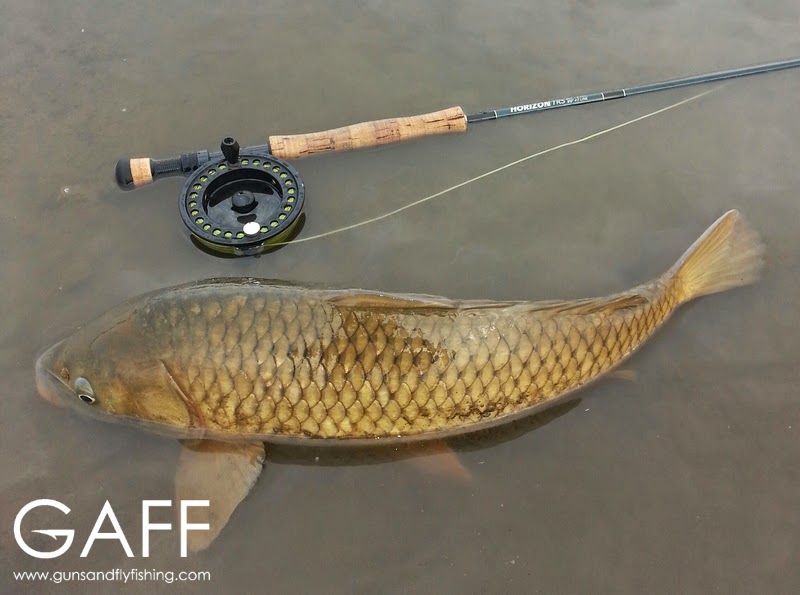
The choice of rod all depends on the conditions you are fishing in and the size of the Carp that you are going to encounter. I use a 5 weight when sight fishing in shallow sandy bays that have no snagging hazards. For this application I would thus recommend a 9 foot, 5 or 6 weight rod with a medium to fast action.

I use my 9 foot, 7 weight on a daily basis at my local waters which has a lot of submerged trees and aquatic vegetation, but even with my 7 weight I have come short a few times, getting bullied by bigger fish. I have lately been experimenting with my 9 weight but I honestly feel that it is a bit over kill. I would then recommend a 9 foot 7 or 8 weight with a medium to fast action as a good all-round rod for targeting big Carp on fly.

When it comes to reels I personally feel that it is the most important piece of equipment. A large arbour reel with at least 150 meters of backing and a strong, smooth drag is required as I have been run to my spool knot on a number of occasions and we all know fly lines these days are not cheap.

Fly Fishing for Carp (2).jpg

On the reel I suggest using a weight forward floating line which will the best choice of fly line for targeting Carp on fly. Be warned though that this is the one thing that does not last when fishing for these guys. Carp know where the structure is and they use this to their advantage which tend to damage the fly line on occasion. I’m using a Rio Carp fly line at the moment and I am very happy with it, but any other weight forward floating line will do.

Other items that I can recommend is a large net, preferably with a diameter of about 500mm as an average Trout net will not suffice. Make sure that the net’s material is made of a soft mesh which will not damage the Carp protective layer of mucus on its body. Polarized lenses are also an essential piece of equipment as you need them for spotting bubbles and also for spotting Carp feeding in deeper water.

Fly Fishing for Carp (3).jpg

Although Carp are listed as an invasive species in South Africa, please handle them with care and the respect that they deserve. Always make sure your hands are wet before handling them and try to get them back into the water as quickly as possible after landing them.

Fly Fishing for Carp (4).jpg

I hope that this information will help you with catching Carp on fly and that you will share the same passion that I have developed for Carp once you have caught one on fly.

© 2015 Guns and Fly Fishing. All Rights Reserved.
Hunting and Fly Fishing in the Karoo

By Stephan Van Der Merwe

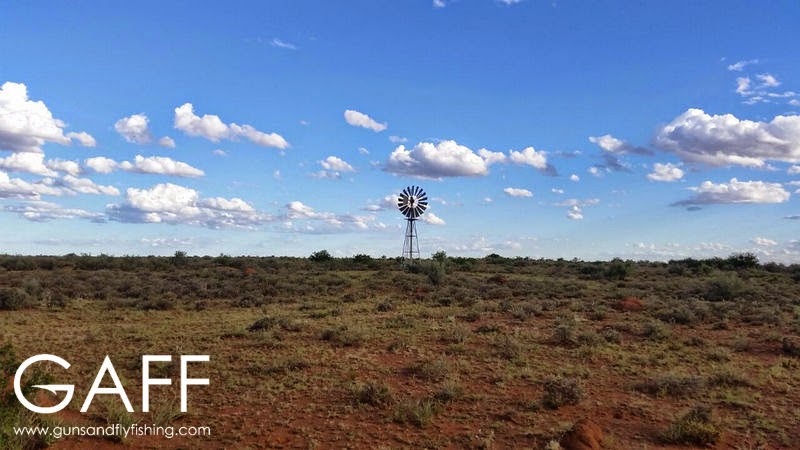
Some might think that the Karoo is nothing more than an arid semi-desert landscape only inhabited by Sheep and scattered with a few succulent shrubs here and there. But for the outdoorsman it is a jewel that is beckoning to be discovered. Hunting opportunities in the Karoo are plentiful and there is much more than just Springbuck and Oryx on offer. However if it is a record book Springbuck ram that you are after, then you most certainly have the best chance of finding it in the Karoo. Outfitters such as Jules of the Karoo are world renowned for delivering the majority of the top 10 Springbuck trophies in both Roland Ward and SCI.

karoo (1).jpg

Now I bet none of you ever thought that the words Karoo and fly fishing will be mentioned in the same sentence, but with both the Orange and Riet Rivers present, the Karoo has some of the best Yellowfish fly fishing on offer in South Africa, whilst also boasting some spectacular scenery.

My fellow GAFF Field Staff representative Emile and I had the privilege of spending a week in the beautiful Karoo near Hopetown to do what we love most, and that is to hunt and fly fish.

We were very fortunate to be given the opportunity to hunt some Springbuck in the time that we were there by a family member of Emile that is a game farmer in the Hopetown district. This was also then where we stayed during our visit to the Karoo. We didn’t waste much time and on the 2nd day of our visit we went on our Karoo hunting adventure.

karoo (2).jpg

The chosen method in which the hunt was to be conducted was a driven hunt, given the type of terrain that we encountered and the short amount of time that we had in which to complete the hunt. For those of you who do not know, a driven hunt is a method used by a lot of outfitters in the Karoo as the landscape mostly consists of wide open spaces and “koppies” (hills) which makes stalking for Springbuck and other game species on foot very challenging.

This is done by placing the hunter in a strategic position after which the animals are then driven toward the hunter’s surrounding area and within acceptable shooting range, with the help of either a vehicle or by horsemen. This is however done in a very subtle manner and does not cause the animals to stress whatsoever. It is pretty much done in the same manner as when you drive around counting the animals in a herd, to give you a good idea.

Our weapon of choice was a Musgrave rifle in 25-06 Remington. This caliber is ideal for the Karoo landscape where a fast, flat shooting calibre is a necessity, as the majority of shots are taken on average between 200 and 400 meters.

IMG-20150112-WA0001.jpg

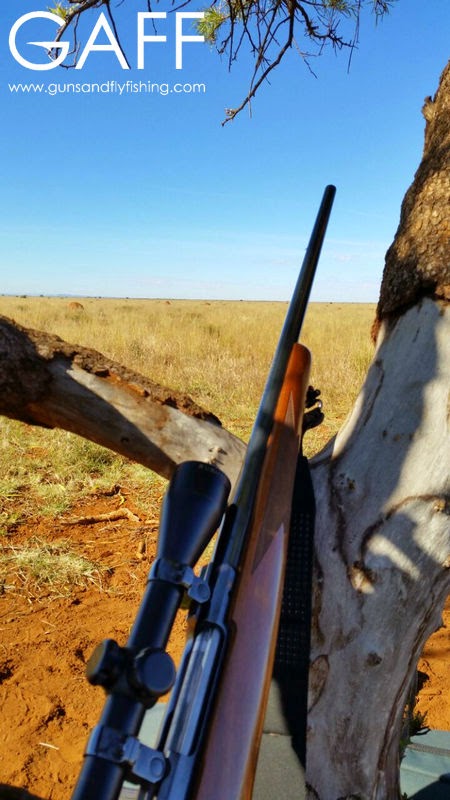
Most of the Springbuck were in a big herd of approximately 200 animals. I dropped Emile off at a tree just below a “koppie” (hill) as this was a good strategic position for him to wait for the animals to move within shooting range. After some persuasive manoeuvring by the hunting vehicle the herd slowly but surely moved toward Emile’s position.

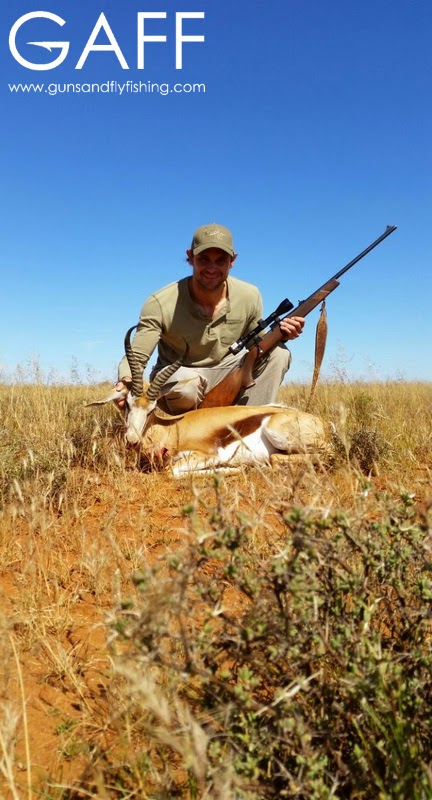
Scanning through the big herd he identified his target which was a big ram and a beautiful representative of the species. The ram stood at 252 metres and by using the tree next to him as support for his rifle, Emile made the shot and the Springbuck ram collapsed right there and then. We took some photos of the beautiful Karoo Springbuck ram and admired the character of its horns.

IMG-20150112-WA0002.jpg

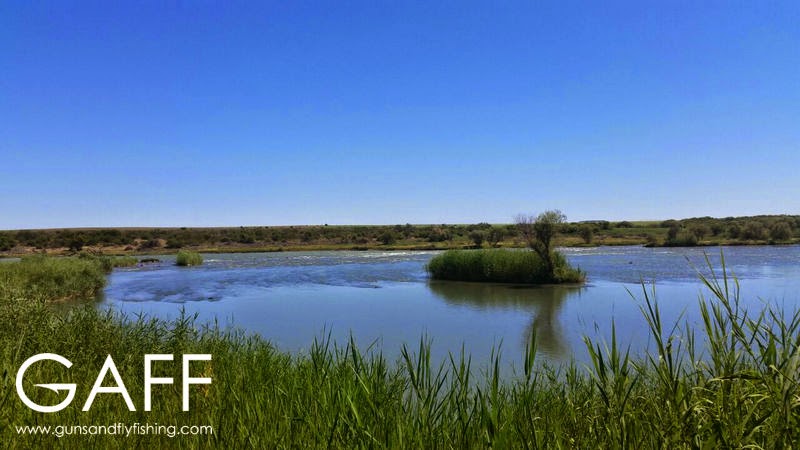
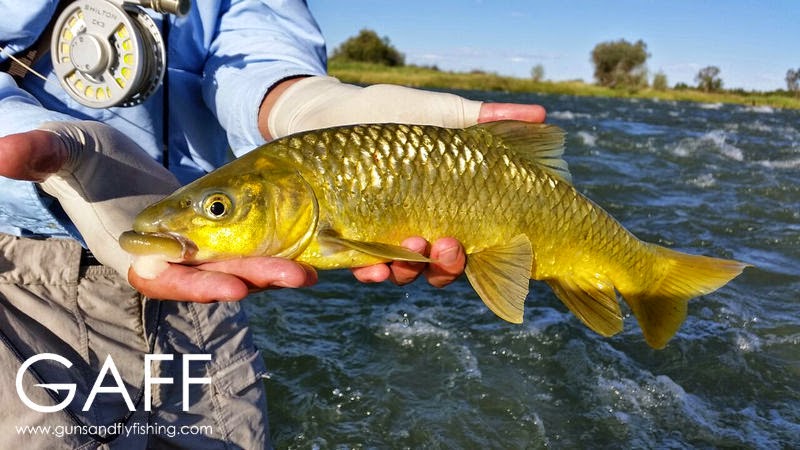
We also spent a day fly fishing the Orange River, just outside of Hopetown. The specific morning we got there was very hot, the flow of the river was high and finding some promising water was rather tricky. Both Emile and I caught a couple of Smallmouth Yellowfish in our first session of the day, but the conditions made it quite challenging and the numbers did not meet our expectations. After a well-deserved lunch (and hiding from the scorching sun) in the shade, we headed back to the river later that afternoon. It was still a blistering 37°C but the flow of the river was down, which made things a bit easier to contend with.

IMG-20150102-WA0000.jpg

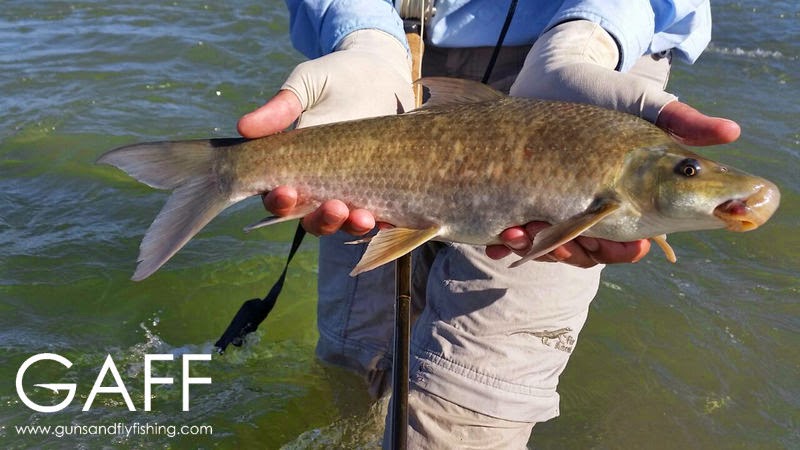
After working our way down the river bank I spotted a rapid that looked promising and I had a good feeling that it would deliver some fish. On my first drift I hooked a fish but unfortunately lost it. Not too long after that Emile caught a nice Mudfish on a #8 Mustard Caddis and it seemed that they were mostly feeding on the bottom as we got more takes, the deeper we started to fish for them.

IMG-20150102-WA0007.jpg IMG-20150102-WA0011.jpg

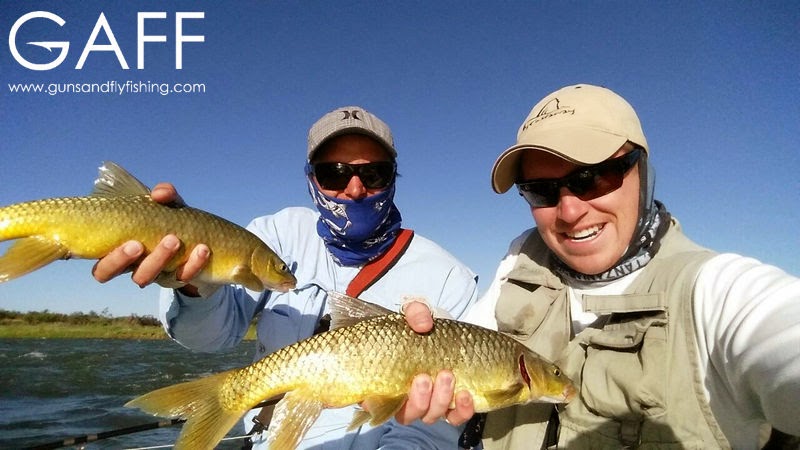
All of a sudden chaos broke out and we started catching fish after fish. It was as if our prayers were answered and the floods gates of heaven opened, full of eager fish willing to take up any offering of feathers and steel. We had a number of double-ups and we didn’t even get a chance to take photographs in between landing fish. We did however manage to take quick selfie of a double-up amidst all the madness.

selfie.jpg

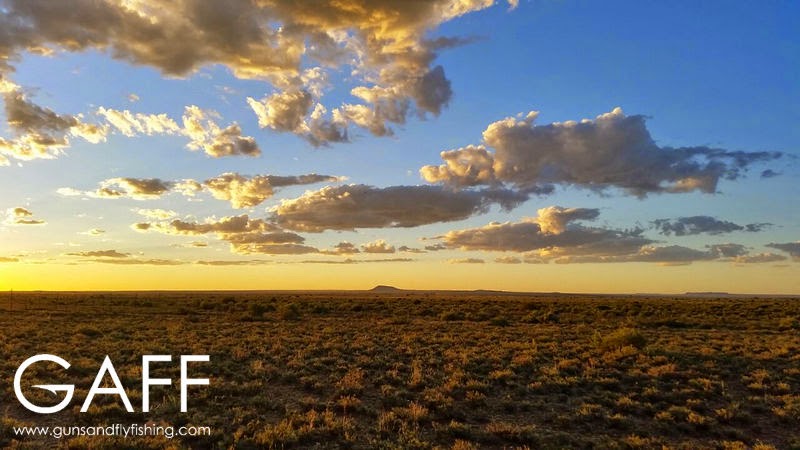
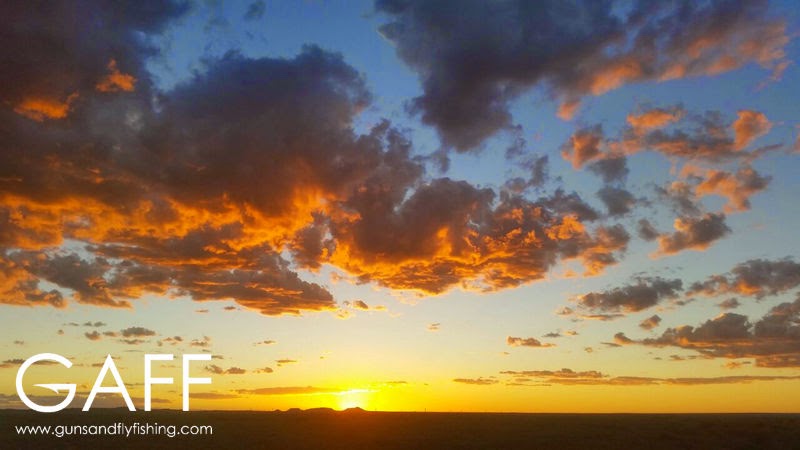
Later that day as the sun set over the stunning Karoo landscape, we both agreed that is was one of our best, if not the best sessions we had ever had fly fishing for Smallmouth Yellowfish.

The Karoo is a very special place, and once you have been there you will keep on going back. It has some of the most beautiful scenery in the country and it has so many activities on offer for the whole family, which is what makes it such an amazing destination.

IMG-20141228-WA0010.jpg

© 2015 Guns and Fly Fishing. All Rights Reserved.
10 South African Fly Fishing Rivers

Now in South Africa we are known for a lot of things, but rivers aren’t really one of them. Though we are blessed with two big rivers, namely the Orange and the Vaal River, most of our rivers (as we call them) might be referred to as streams or creeks by Americans or Europeans. Rivers in the US such as the Yellowstone, Henry’s Fork and Delaware to name a few are littered with Trout and are crystal clear (we haven’t been yet there but it looks pretty awesome on the internet).

Other countries such as Zealand, Slovenia and Patagonia also have their fair share of aquatic utopias and are also world famous for their trophy Trout specimens.
Trout are unfortunately not indigenous to South Africa but they were thankfully introduced in the early 1900’s into certain streams in South Africa where the water was cold enough for them to adapt and survive.

Though in general they do not grow here to the proportions of their ancestors in the northern hemisphere, there are some places where 10 lbs and 25” fish have been encountered. Lesotho is one of these places and it is probably Africa’s best representations of a wild Trout paradise.

If you travel a bit north that is where you will find Africa’s most famous rivers, namely the Zambezi, the Congo and the Nile. These are some serious bodies of water with the Nile being the longest in the world and the Congo being the deepest in the world. These massive rivers also have massive fish found in them that can be targeted on fly, with Nile Perch in the Nile River and Goliath Tigerfish in the Congo River.

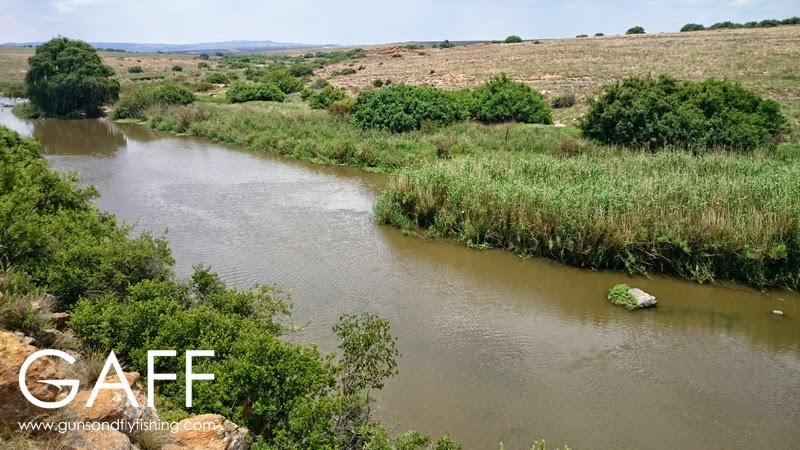
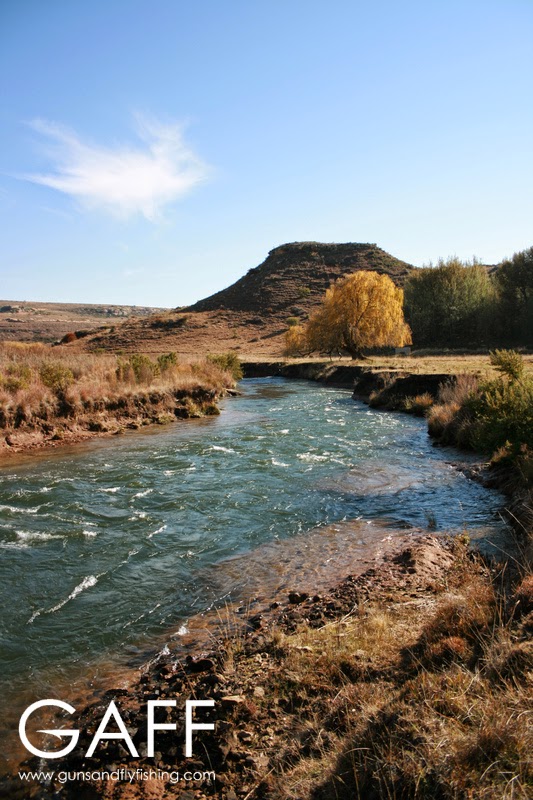
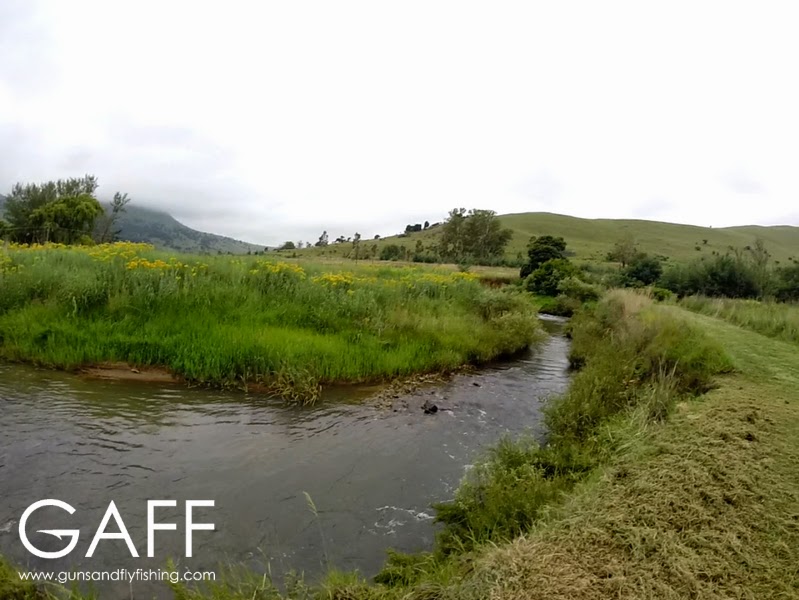
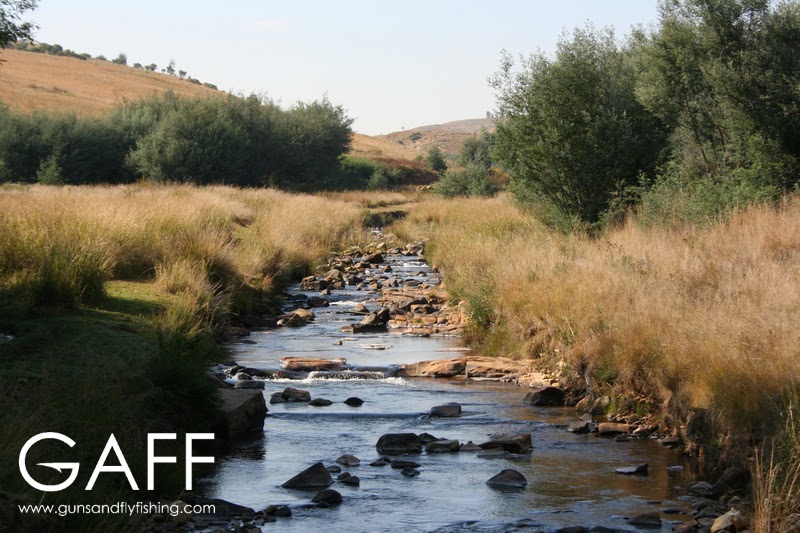
Getting back to South African rivers, we do have some spectacular rivers and streams that we can be proud of. So we thought that we would put together a list of 10 rivers that we at GAFF have fly fished before as well as the fish species that they are most well known for. Some of these rivers we frequently visit and others we might only see once or twice a year, but we keep on going back to them.

1. The Vaal River – Parys, Free State Province: Smallmouth Yellowfish, Largemouth Yellowfish, Mudfish, Sharptooh Catfish, Carp.

Vaal River.jpg

2. The Broederstroom River – Haenertsburg, Limpopo Province: Brown Trout, Smallscale Yellowfish and Rainbow Trout.

Broederstroom River (1).jpg

3. The Smalblaar River – Du Toit’s Kloof, Western Cape Province: Brown Trout, Rainbow Trout and Smallmouth Bass.

Smalblaar River.jpg

4. The Bushmans River – Giant’s Castle, Kwazulu Natal Province: Brown Trout, Rainbow Trout and Natal Yellowfish (Scaly).

Bushmans River.jpg

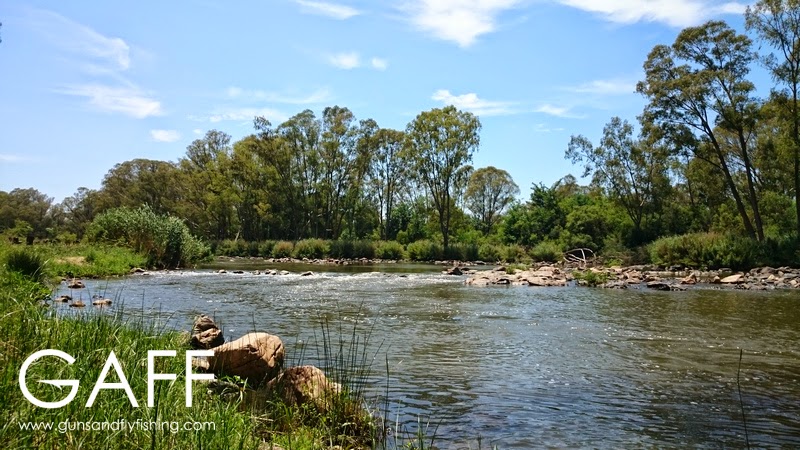
5. The Orange River – Hopetown, Northern Cape Province: Smallmouth Yellowfish, Largemouth Yellowfish, Mudfish, Sharptooh Catfish.

Orange River.jpg

6. The Mooi River – Kamberg, Kwazulu Natal Province: Brown Trout, Rainbow Trout and Natal Yellowfish (Scaly).

Mooi River.jpg

7. The Suikerbosrand – Heidelberg, Gauteng Province: Smallmouth Yellowfish, Largemouth Yellowfish, Mudfish, Sharptooh Catfish, Carp.

Suikerbosrandt River.jpg

8. The Ash River – Clarens, Free State Province: Brown Trout and Rainbow Trout.

Ash River.jpg

9. The Dorps River – Lydenburg, Mpumalanga Province: Brown Trout, Smallscale Yellowfish and Rainbow Trout.

Dorps River (1).jpg

10. The Witpoort River – Dullstroom, Mpumalanga Province: Brown Trout, Smallscale Yellowfish and Rainbow Trout.

Witpoort River.jpg

© 2015 Guns and Fly Fishing. All Rights Reserved.
« Older posts Newer posts »

© 2026 Guns and Fly Fishing. All Rights Reserved.
Theme by Anders NorenModified by RooiWillie